


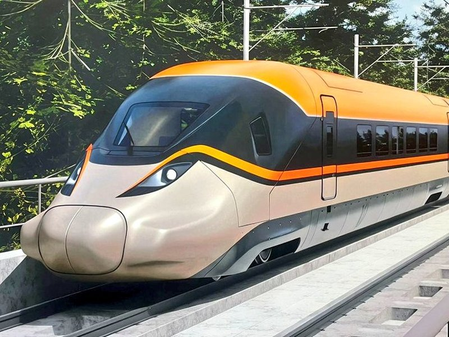
India is on the verge of finishing its inaugural bullet train corridor, the Mumbai-Ahmedabad High-Speed Rail (MAHSR) project, which will serve as a model for future bullet train routes in the country. The MAHSR will link Mumbai to Ahmedabad in approximately 1 hour and 58 minutes, boasting a design speed of 350 kmph and an operational speed of 320 kmph supported by advanced technology in rolling stock, signaling, and train control systems.
Covering around 508 kilometers with 12 planned stations, the corridor is set to commence operations in August 2027, starting with the section between Surat and Vapi. The Mumbai-Ahmedabad High-Speed Rail project is instrumental in developing the necessary knowledge, capabilities, and industrial ecosystem for future expansions, as stated by the government.
According to official sources, the project is laying the groundwork for future high-speed rail extensions by establishing a scalable model. This initiative is expected to enhance connectivity, reduce travel durations, and contribute to long-term economic progress as new corridors are introduced.
The government has identified seven high-speed rail corridors spanning nearly 4,000 kilometers for prospective development, with an estimated investment attraction of approximately Rs 16 lakh crore. By leveraging a standardized template based on the MAHSR project, the aim is to implement proven engineering designs, construction techniques, and operational procedures to enhance efficiency and expedite project completion.
The adoption of unified designs, components, and maintenance protocols will streamline spare-part management, training, and procurement processes across the network. Additionally, the foundation designs will be tailored to specific soil characteristics at each location, while other subsystems will adhere to common engineering standards, encompassing piers, viaducts, tracks, station structures, overhead electrification, and signaling systems. This strategic approach is anticipated to facilitate rapid construction across upcoming corridors, enhancing quality and reducing costs for future high-speed rail projects.
