


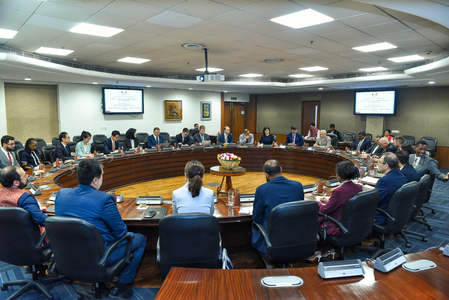
India effectively navigated a significant diplomatic hurdle during the recent BRICS Ministerial Summit in New Delhi on May 14–15, 2026, amidst rising tensions between Iran and the United Arab Emirates (UAE). The two-day summit, chaired by India, concluded without the issuance of a customary joint statement for the first time in BRICS history. Instead, India released a Chair’s Statement and Outcome Document due to deep divisions between Iran and the UAE.
The summit coincided with the US-China summit in Beijing, where US President Donald Trump engaged in discussions with Chinese President Xi Jinping. Notably, China’s foreign minister was absent from the BRICS meeting as Beijing focused on hosting the American delegation. The crisis stemmed from contradictions arising after the 2024 BRICS expansion, supported by China, which brought Iran and the UAE into the grouping despite their longstanding regional rivalry.
Iranian Foreign Minister Abbas Araghchi urged BRICS members to denounce alleged violations of international law by the United States and Israel. In contrast, UAE Minister of State Khalifa bin Shaheen Al Marar dismissed the accusations and accused Iran of justifying attacks against Gulf nations. The Foreign Ministers’ meeting was initially intended to prepare for the BRICS heads-of-state summit scheduled for September 2026, focusing on trade finance, local currency settlements, UN reforms, and the New Development Bank (NDB).
However, discussions primarily revolved around the ongoing conflict involving Iran, Israel, and the United States. The handling of the Summit by India was described as reflecting “pragmatic realism,” emphasizing that BRICS should be seen as a flexible cooperation platform rather than a fully unified geopolitical bloc. India’s approach underscored the significance of constructive engagement while managing internal contradictions within the expanded grouping. According to India’s Sherpa for BRICS and Secretary in the Ministry of External Affairs, Sudhakar Dalela, the document reflected the “common position” of members on nearly all subjects. As the BRICS chair, External Affairs Minister (EAM) S. Jaishankar acknowledged differing views among some members regarding the West Asia/Middle East situation.
