


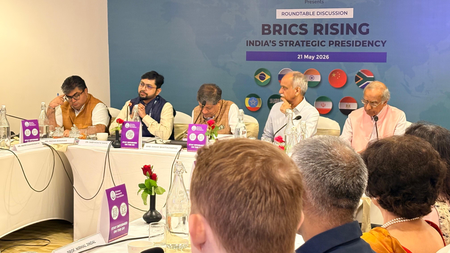
India’s upcoming presidency of BRICS in 2026 comes during a time of significant global geopolitical and economic instability. Representatives from government and industry highlighted the opportunity for India to shape a more stable international order. The Chintan Research Foundation organized a roundtable in New Delhi titled “BRICS Rising: India’s Strategic Presidency.”
The discussion involved former BRICS Sherpas, diplomats, and members of the strategic community, focusing on India’s potential role in guiding BRICS through uncertain times. The CRF emphasized that BRICS should be viewed as a platform for multipolarity, economic cooperation, and trust-building rather than binding agreements like FTAs. The roundtable explored ways India’s presidency could enhance practical cooperation within BRICS in geopolitics and geoeconomics.
Participants deliberated on the challenges posed by a fragmented world marked by sanctions, protectionism, and uncertainty in global trade. They discussed how BRICS can transition from shared aspirations to producing tangible outcomes. The conversation also addressed the evolving nature of BRICS in a more diverse setting, emphasizing the importance of maintaining cohesion and a clear sense of purpose amidst expansion.
The roundtable underscored the significance of BRICS’ relationship with the Global South and the need to uphold its identity as a voice for developing countries. Participants stressed the importance of aligning BRICS’ priorities with those of its members, including development and global governance reform. India’s role as a bridge between different perspectives within BRICS was highlighted, focusing on initiatives in trade, investment, digital interoperability, and institutional reform.
The economic aspect of BRICS cooperation was also examined, with a focus on enhancing intra-BRICS trade and economic integration. Areas identified for attention included trade facilitation, digital governance, and reducing regulatory frictions to promote structured integration. Participants emphasized the need for practical mechanisms to enhance connectivity and reduce barriers among BRICS+ economies, such as coordination on payment systems and infrastructure connectivity.
The discussion concluded with the consensus that BRICS+ under India’s presidency has the opportunity to showcase the relevance of multilateral cooperation in a fragmented world. While maintaining realistic expectations, the grouping can contribute significantly by promoting practical cooperation, institutional reform, and a more balanced global order. India’s presidency presents a platform to strengthen its diplomatic standing and shape a more coherent and consequential vision for BRICS.
