


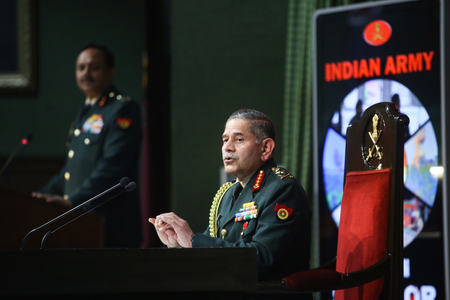
Indian Army Chief, General Upendra Dwivedi, clarified that there were no discussions on nuclear warfare between the Directors General of Military Operations (DGMOs) of India and Pakistan during Operation Sindoor. He emphasized that the significant destruction in Pakistan resulted from India’s resolute anti-terrorism actions, made possible by expanding conventional military operations. Gen Dwivedi highlighted that the military did not engage in nuclear rhetoric during the talks, attributing such statements to politicians and the public in Pakistan.
The Army chief underscored the importance of conventional operations, noting that the armed forces’ ability to escalate actions against terrorism was facilitated by enlarging the conventional operational space. He mentioned that the recent military actions, particularly in response to firing incidents in Jammu and Kashmir, led to the elimination of around 100 Pakistani personnel, showcasing the effectiveness of expanding the conventional domain.
Gen Dwivedi pointed out that despite a reduction in forward movements post-Operation Sindoor, eight active terror camps persist along the International Border (IB) and Line of Control (LoC). Security forces are closely monitoring these camps, anticipating any potential threats. The Army chief affirmed readiness to address any provocative actions from these camps, maintaining a vigilant stance to prevent any untoward incidents.
The Army chief also highlighted that ongoing vigilance post-Operation Sindoor remains crucial, with continuous monitoring of forward movements by both India and Pakistan. He assured that necessary actions have been taken to address any emerging security challenges swiftly, underscoring the commitment to maintaining a proactive defense posture.
