


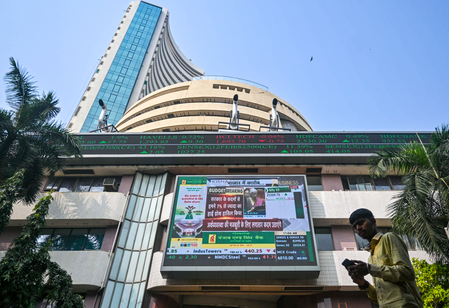
The Indian equity markets showed a positive trend early on Monday, recovering from the losses incurred on Budget Day, despite negative global cues. By 9:33 am, Sensex rose by 373 points, or 0.46%, reaching 81,096, while Nifty gained 87 points, or 0.35%, settling at 24,913. However, main broad-cap indices experienced losses, with Nifty Midcap 100 declining by 0.50% and Nifty Smallcap 100 by 0.85%.
All sectoral indices, except for metal, realty, and oil and gas, were in the red. Notably, Nifty consumer durables and IT sectors were major losers, down by 1% and 0.61% respectively. Market analysts pointed out that immediate support is at the 24,650-24,700 zone, with resistance at the 25,950–25,000 zone. They attributed the market selloff on Budget Day to a knee-jerk reaction to the sharp increase in STT on F&O trades, aimed at discouraging retail traders from complex F&O trading, where 92% were losing money.
The Budget’s projection of a 10% nominal GDP growth is seen as achievable, potentially delivering around 15% earnings growth in FY27. However, analysts noted that a significant market upturn might take time, especially with a possible retreat from AI trade globally. In the Asia-Pacific region, markets experienced losses in the morning session as investors analyzed private data on China’s January factory activity.
Asian markets saw declines, with China’s Shanghai index down by 1.32% and Shenzhen by 1.41%, while Japan’s Nikkei declined by 0.52% and Hong Kong’s Hang Seng Index by 2.15%. South Korea’s Kospi also dipped by 4%. In the US markets, the last trading session ended mostly in the red, with Nasdaq losing 0.94%, S&P 500 easing by 0.43%, and Dow declining by 0.36%. On February 1, foreign institutional investors (FIIs) net sold equities worth Rs 588 crore, with domestic institutional investors (DIIs) also net sellers of equities worth Rs 683 crore.
