


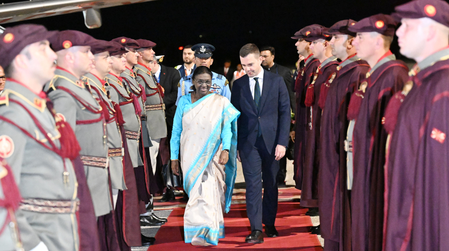
President Droupadi Murmu received a warm welcome in North Macedonia during the second part of her three-nation tour. This historic visit marks the first time an Indian President has visited North Macedonia, showcasing the strengthening bilateral relations between the two nations. The visit aims to enhance cooperation across various sectors and deepen the ties between India and North Macedonia.
President Murmu’s itinerary in North Macedonia includes meetings with President Gordana Siljanovska-Davkova and Prime Minister Hristijan Mickoski. Additionally, she is scheduled to engage with the President of the Assembly, address the Assembly, and participate in the India-North Macedonia Business Forum. The visit is expected to foster collaboration in agriculture, pharmaceuticals, science and technology, information technology, and IT-enabled services.
In Moldova, President Murmu held talks with Moldovan President Maia Sandu, emphasizing bilateral cooperation in technology, agriculture, and affordable medicine. She also addressed the India-Moldova Business Forum to boost trade and investment between the two countries. The final leg of her tour will lead President Murmu to Romania, where she will engage with President Nicuşor Dan and interim Prime Minister Ilie Bolojan. The visit signifies the first trip by an Indian President to Romania in over thirty years.
During her stay in Romania, President Murmu will conduct discussions with key Romanian officials, including Senate President Mircea Abrudean and Chamber of Deputies President Sorin Grindeanu. She will also participate in the India-Romania Business Forum and interact with the Indian diaspora. The Ministry of External Affairs highlighted Romania’s significance as a crucial partner for India within the European Union, with expectations of strengthening economic ties through the proposed India-EU Free Trade Agreement. President Murmu’s State Visits underscore India’s commitment to fostering relationships with Eastern European nations and expanding engagement in the region through political dialogue, trade, investment, and people-to-people exchanges.
