


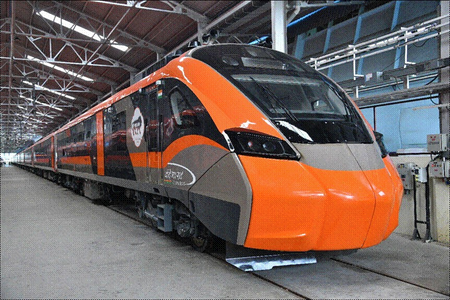
Indian Railways completed the last high-speed trial of the indigenous Vande Bharat Sleeper Train, a significant advancement in India’s pursuit of modern rail technology. The trial, overseen by the Commissioner of Railway Safety on the Kota–Nagda route, saw the train reaching a speed of 180 kmph. The ministry confirmed the train’s successful performance across safety and technical aspects, marking the trial as a success.
The high-speed assessment included thorough evaluations of ride stability, vibration behavior, braking systems, emergency response, and other safety features. The train demonstrated stability and safety at elevated speeds, meeting a crucial regulatory milestone. Union Minister Ashwini Vaishnaw, responsible for Railways, Information Broadcasting, and Electronics & Information Technology, shared a video of the trial on social media.
The video showcased the Vande Bharat Sleeper Train smoothly running at 180 kmph and featured a water-glass test, demonstrating steady glasses without spillage. The demonstration emphasized the train’s advanced suspension system and superior comfort for passengers. The 16-coach train, designed for long-distance journeys, offers modern amenities to enhance passenger safety and comfort.
Featuring comfortable sleeper berths, automatic doors, improved suspension, modern toilets, digital passenger information systems, and energy-efficient technologies, the Vande Bharat Sleeper Train prioritizes passenger well-being. Safety and technology enhancements include the KAVACH automatic train protection system, crashworthy couplers, anti-climbers, and fire barrier doors. The train also incorporates regenerative braking for energy efficiency, UV-C air disinfection, centrally controlled plug doors, and wider gangways.
Emergency communication systems enable direct contact with the train manager or loco pilot, with special provisions for Divyangjan passengers.
