


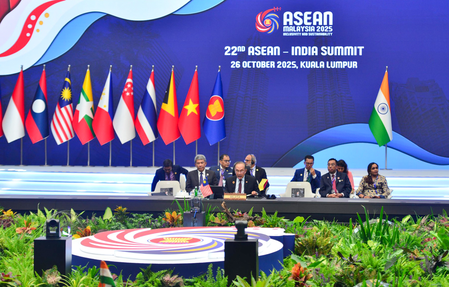
India’s Act East Policy, spearheaded by Prime Minister Narendra Modi’s government, has led to a more focused interaction with the Association of South-East Asian Nations (ASEAN). This strategic shift underscores a growing emphasis on the Indo-Pacific over the Asia-Pacific, marking a significant change in diplomatic discourse, as per a report.
The evolution of the India-ASEAN relationship from optimism in 2017 to resurgence in 2022 and now strategic repositioning reflects a deepening partnership. Initially an extension of India’s Look East Policy, this collaboration has weathered geopolitical challenges and global order disruptions, notes ‘The Geo Strata’ report.
Amid increasingly polarized regional strategic narratives, there is a notable influence from external power dynamics. The emphasis on a free and open Indo-Pacific through institutionalized narratives has gained paramount importance for regional stability, the report emphasizes.
To enhance the India-ASEAN narrative, a shift towards development-focused frameworks is crucial, necessitating effective institutionalization. The report also highlights the significance of initiatives like the India-Myanmar-Thailand Trilateral Highway and the Mekong-Ganga corridor in reinforcing economic connectivity and asserting India’s autonomy in the Indo-Pacific region.
Emphasizing the need for India-ASEAN cooperation to focus on global leadership, trade competitiveness, and strategic sustainability, the report underscores the importance of middle-power dynamics in diluting geopolitics. By balancing relations with China without involving ASEAN in direct confrontations, India strengthens its credibility as an inclusive regional player.
