


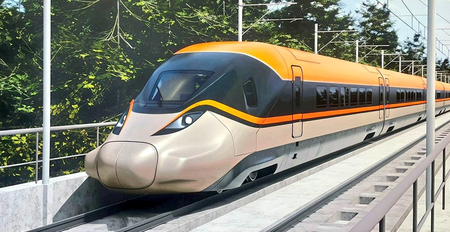
A framed image at the Ministry of Railways in New Delhi showcases India’s envisioned bullet train, symbolizing progress on the long-awaited Mumbai-Ahmedabad High-Speed Rail project. After nearly nine years since its inception, the ambitious venture has achieved significant construction milestones, signaling a renewed push towards completion.
Union Railway Minister Ashwini Vaishnaw recently reported substantial progress on the project, with 349 km of viaduct structure already completed out of the 508-km route. This elevated viaduct, a crucial element of the project, represents a major step forward in the high-speed rail’s development.
The National High-Speed Rail Corporation Limited (NHSRCL) has made notable strides in the construction, including the erection of 443 km of support pillars and installation of over 7,700 overhead equipment masts. These advancements underscore the project’s steady advancement towards its finalization.
In Maharashtra, a challenging section of the project, significant headway has been made after facing obstacles related to land acquisition and political opposition. Notably, 5 km of the 21-km underground tunnel between Mumbai’s Bandra-Kurla Complex and Shilphata has been excavated, marking a crucial achievement in the corridor’s construction progress.
The Mumbai-Ahmedabad corridor, set to link 12 stations across Maharashtra and Gujarat, is rapidly taking shape. With station construction well underway in Gujarat and Maharashtra, the project is moving towards its goal of enhancing connectivity and revolutionizing rail travel in the region.
India’s first indigenous high-speed trains for the corridor are currently in development, marking a shift towards self-reliance in rolling stock production. Scheduled to operate at speeds up to 280 kmph, these trains signify a significant technological leap in the country’s rail infrastructure.
Plans for two service categories on the route aim to significantly reduce travel time between Mumbai and Ahmedabad. The faster service, stopping only at Surat and Vadodara, could cut the journey time to just over two hours, offering commuters a swift and efficient travel option.
Conventional rail services between the two cities currently take around seven hours, highlighting the transformative impact the high-speed rail project is poised to have on intercity travel in India.
