


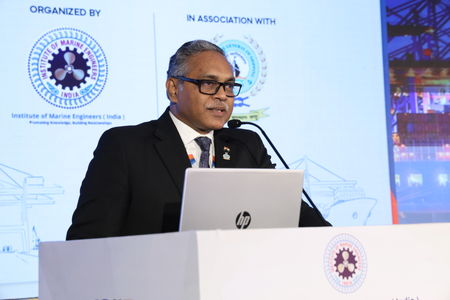
India’s maritime sector is set to play a crucial role in the country’s economic expansion and global competitiveness as per the Viksit Bharat 2047 vision, highlighted by Director General of Shipping Shyam Jagannathan. The maritime industry, including policymakers, industry leaders, technologists, academicians, and professionals, convened at COMARSEM 2026 to emphasize the strategic importance of the Blue Economy in fostering sustainable growth. Over 90% of India’s trade volume relies on sea routes, making the maritime sector central to the nation’s trade, logistics, and infrastructure landscape.
Shyam Jagannathan pointed out that India is enhancing its global presence in shipping and maritime services with a fleet of over 1,520 merchant vessels and a gross tonnage capacity exceeding 13 million. The country is positioning itself as a prominent hub for the Blue Economy through targeted policy measures spanning ports, shipbuilding, logistics, renewable energy, and related maritime sectors. India aims to rank among the top 10 shipbuilding and ship repair nations globally by elevating its capacity from 30,000 gross tonnage to over 500,000 gross tonnage.
Sustainability forms a cornerstone of India’s maritime strategy, with a focus on initiatives like utilizing more than 60% renewable energy at major ports, creating green spaces in at least one-third of port areas, and fostering circular economy practices through ship recycling. The Alang–Sosiya cluster in Gujarat, housing 115 yards compliant with the Hong Kong Convention, plays a pivotal role in supporting the Green Steel ecosystem and generating substantial employment opportunities. Shyam Jagannathan highlighted the Maritime Amrit Kaal Vision 2047, which aims to secure a top-five global position in shipbuilding while maintaining leadership in ship recycling.
India’s maritime goals include developing carbon-neutral ports, encouraging green and alternative fuels, establishing green bunkering infrastructure, and offering incentives for low-emission vessels, such as 20–30% financial aid for green shipbuilding and retrofitting. Jagannathan emphasized that embracing green shipping is vital for competitiveness in a low-carbon global economy, aligning India’s transition with various strategic frameworks like Maritime India Vision 2030, Maritime Amrit Kaal Vision 2047, the IMO’s Net Zero 2050 roadmap, and India’s Panchamrit commitments. He urged professional bodies like the Institute of Marine Engineers (India) to collaborate closely with the authorities to effectively implement these new strategies.
