


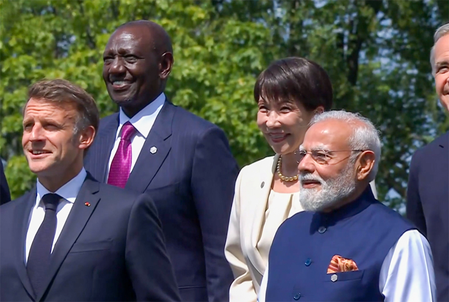
India’s involvement in the G7 bolsters the group’s significance in a world with multiple power centers, notes a report. While the G7’s influence is more political than institutional, India gains prestige, networking opportunities, and a chance to shape discussions through engagement. Although not a member, India has compelling reasons to actively participate in the G7.
The G7 serves as a crucial platform for India to interact collectively with Europe, comprising key Western European nations and the EU. India, traditionally focused on its immediate region and major powers, has increasingly strengthened ties with Europe in recent years. The 2026 G7 Summit saw India participating as a guest for the 13th time, with Prime Minister Narendra Modi attending his seventh forum since 2019.
India’s repeated invitations to the G7 highlight its importance in global dialogues, despite not being a member of the exclusive club of advanced industrial democracies. The invitation to the 2026 summit was influenced by the strong India-France partnership and deepening India-Europe relations, reflecting India’s role as a prominent voice of the Global South and its current BRICS Presidency.
India’s unique position as a rising power representing the Global South allows it to advocate on various global issues in ways that resonate with developing countries. Unlike China, India’s presence at the G7 underscores its support for a rules-based international order and strategic autonomy. Its democratic values, open economy, and preference for reform over upheaval make India a more favorable partner for the G7 compared to China.
