


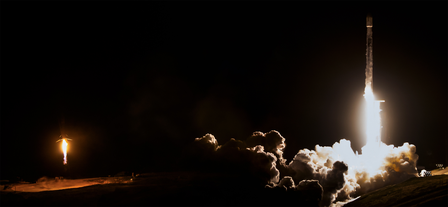
The Indian Space Association highlighted that the successful launch of Mission Drishti showcases India’s private space sector reforms and signifies a shift towards advanced surveillance capabilities. Lt. Gen. AK Bhatt (Retd.), Director General of the industry body, emphasized the significance of this achievement, indicating a transformation in India’s Earth observation approach and the growing maturity of the private space industry. The mission illustrates the ability of private entities to provide crucial technologies applicable in national security and disaster response scenarios.
The launch of GalaxEye’s first satellite under Mission Drishti, the largest ever constructed by an Indian private company, is a significant development in India’s Earth observation strategies. This event not only signifies a proof-of-concept for the country’s private space sector reforms but also represents a crucial step towards establishing sovereign, all-weather surveillance capabilities essential for national security and disaster management. Bengaluru-based startup GalaxEye’s successful launch of Mission Drishti’s commercial satellite, described as the world’s first OptoSAR satellite, marks a notable advancement in Earth observation technologies and reinforces India’s growing presence in the global space domain.
Mission Drishti, weighing approximately 190 kilograms, stands as India’s largest privately developed Earth observation satellite, offering a unique combination of Electro-Optical (EO) and Synthetic Aperture Radar (SAR) sensors in a single platform. This integration enables imaging in diverse weather conditions, ensuring operational capabilities round the clock. Lt. Gen. AK Bhatt (Retd.) highlighted the technological breakthrough achieved by GalaxEye through the commercialization of OptoSAR, a feat accomplished by only a few global players. The seamless integration of optical and radar capabilities in Mission Drishti sets a new standard for persistent, all-weather intelligence, with downstream applications playing a crucial role in defining value in the space economy, particularly in Earth observation where timely insights are vital.
Designed as a dual-use satellite, Mission Drishti supports various applications such as defense, agriculture, disaster management, maritime monitoring, and infrastructure planning. It is expected to provide high-resolution imagery and reliable data even in challenging environmental conditions, addressing the limitations of traditional optical satellites affected by cloud cover and darkness while leveraging radar imaging strengths.
