


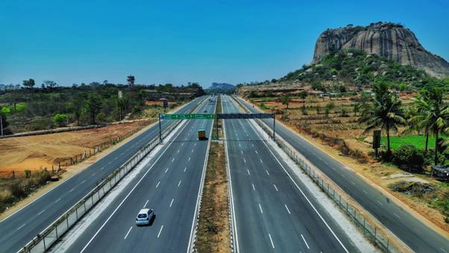
India has experienced a remarkable transformation in its road infrastructure over the last 12 years. Initiatives like Bharatmala Pariyojana and the rapid expansion of the National Highway network have played a crucial role in this development. Bharatmala Pariyojana, a flagship program aimed at enhancing freight and passenger movement across the country, has seen significant progress. By March 2026, projects covering 26,425 kilometers had been awarded, with 22,590 kilometers already constructed.
The National Highway network in India has witnessed substantial growth, expanding from around 91,287 kilometers in 2014 to over 146,572 kilometers in the fiscal year 2025-26. This represents a notable increase of almost 61%. The pace of construction has also accelerated, with the average daily construction rate rising from about 11.6 kilometers in 2013-14 to nearly 34 kilometers in 2025. This growth has greatly improved connectivity between states and regions, facilitating faster movement of goods and services.
One of India’s ambitious highway projects is the Delhi–Mumbai Expressway, set to become the country’s longest access-controlled expressway upon completion. Spanning approximately 1,386 kilometers with an estimated cost of around Rs 1 lakh crore, this expressway will connect major economic centers like Delhi, Haryana, Rajasthan, Madhya Pradesh, Gujarat, and Maharashtra. The project aims to enhance connectivity and reduce travel time between these regions, fostering economic growth and industrial development.
The Delhi–Meerut Expressway has significantly improved connectivity within the National Capital Region, enabling faster and safer travel between Delhi and Meerut. With a cost of about Rs 8346 crore and a length of approximately 82 kilometers, this expressway has reduced travel time for commuters and businesses. Similarly, the Dwarka Expressway, spanning nearly 29 kilometers and developed at a cost of around Rs 9,000 crore, has played a vital role in enhancing connectivity between Delhi and Gurugram.
The Bengaluru–Mysuru Expressway, a landmark project in southern India, has been developed at a cost of roughly Rs 8,480 crore. Stretching over 118 kilometers, this expressway has significantly reduced travel time between Bengaluru and Mysuru. Another notable project, the Delhi – Dehradun Economic Corridor, a 213 km long six-lane access-controlled corridor developed at a cost of Rs 12,000 crore, has substantially cut down travel time between Delhi and Dehradun.
