


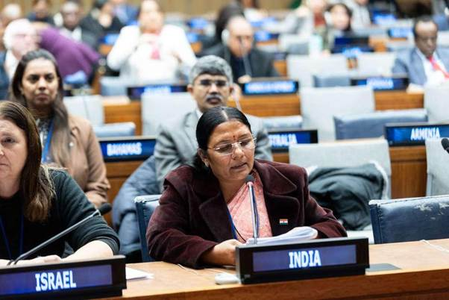
India’s Minister of State for Women and Child Development, Savitri Thakur, emphasized the importance of social justice in India’s Viksit Bharat goals during the 64th session of the UN Commission for Social Development in New York. Thakur led the Indian delegation and showcased India’s rights-based, inclusive, and people-centric development approach at the UN meeting.
Thakur stated that social justice is a key element of India’s national vision for Viksit Bharat@2047. She pointed out that India’s governance philosophy of ‘Sabka Saath, Sabka Vikas’ reflects a comprehensive strategy involving the government and society to ensure dignity, equity, and opportunities for all.
India’s efforts towards social protection and inclusion were highlighted by Thakur, mentioning that more than 800 million people benefit from food security programs in the country. Additionally, over 550 million citizens receive free healthcare services through a vast network of health and wellness centers.
Affordable medicines and medical devices are made available through 16,000 Jan Arogya Kendras, while more than 1.45 million elected women representatives contribute to local governance, showcasing India’s dedication to grassroots democracy.
Flagship initiatives like Beti Bachao Beti Padhao and Sukanya Samriddhi Yojana are enhancing education and financial security for girls, and labor reforms in India are fostering equal pay, safe workplaces, and increased women’s workforce participation.
Furthermore, through large-scale collateral-free loans, millions of women, entrepreneurs, and street vendors have been empowered to join the formal economy. Targeted programs such as SMILE are aiding in the rehabilitation and inclusion of transgender individuals and other vulnerable communities.
Thakur emphasized that India’s development path integrates digital public infrastructure, direct benefit transfers, and citizen engagement to ensure transparency and efficient service delivery. She also reiterated India’s belief in “Vasudhaiva Kutumbakam,” highlighting the country’s commitment to global partnerships and sharing its developmental experiences to promote social justice worldwide.
