


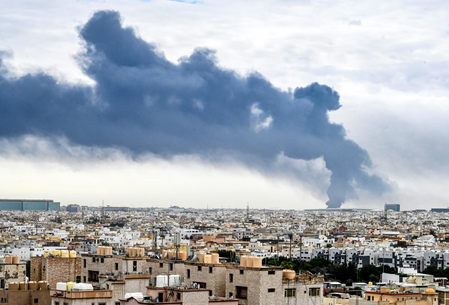
Iran’s Islamic Revolutionary Guards Corps (IRGC) announced retaliatory strikes against US special operations command center in Syria, American weapons depots and launchers in Kuwait, and radar sites in Oman. The operations were part of Operation Nasr-2’s 11th, 12th, and 13th waves. During the 11th wave, a surprise strike was carried out on the US special forces command center in Syria’s al-Tanf region.
The IRGC’s Public Relations Department confirmed that Iranian forces targeted a missile defense surveillance radar, US weapons depots, HIMARS launchers, and missiles in Kuwait. Subsequently, they destroyed a naval surveillance radar in the Salmah Plateau and a US air surveillance radar in Oman. Kuwaiti Army reported that its air defenses were countering hostile missile and drone attacks following Iran’s actions, urging people to follow security instructions.
In a separate incident, Iran’s IRGC conducted retaliatory strikes against US military facilities in Bahrain and Jordan. The Aerospace Force targeted the US military base at al-Azraq in Jordan, destroying shelters housing US fighter jets and strategic drones. The IRGC also attacked the US Fifth Fleet’s facilities in Bahrain, aiming at the NSI management center, military warehouses, command and control center, and fuel storage facilities.
The Strait of Hormuz, a vital energy corridor linking the Persian Gulf with the Gulf of Oman and the Arabian Sea, was mentioned in the context of the US deploying naval forces and controlling maritime routes. The IRGC’s actions were in response to perceived US aggression and strategic positioning in the region.
