
Close Menu
  • Indian Festivals 2026
  • Movie & OTT Releases This Week
  • News
  • Entertainment
  • NRI Life
  • Research
  • Advertise with us
Facebook X (Twitter) Instagram YouTube
  • Download Indian Community App
  • Advertise Here
Facebook X (Twitter) Instagram
Indian CommunityIndian Community
Trending
  • Jetlee (2026) Review: Satya Steals the Sky in This Turbulent But Fun Telugu Action-Comedy
  • Glory (2026) Review: A Riveting Sports Drama That Packs a Powerful Punch
  • Undekhi Season 4 Review: Darker, Deeper, and More Gripping Than Ever
  • Sapne Vs Everyone Season 2 Review: A Raw, Riveting Tale of Dreams, Ambition & Survival
  • KD: The Devil 2026 Review: Dhruva Sarja’s Underworld Epic Is a Bold, Ambitious Saga
  • Patriot (2026) Movie Review: Mammootty and Mohanlal’s Legendary Reunion Delivers a Gripping Surveillance Thriller
  • Kara Movie Review: Dhanush Delivers a Gripping Slow-Burn Thriller You Cannot Miss
  • Raja Shivaji (2026) Movie Review: Riteish Deshmukh’s Grand Epic Is a Majestic Tribute to the Warrior King
  • Indian Festivals 2026
  • News
    • National
    • International
    • Entertainment
    • Achievements
    • Scam Alerts
    • Business
    • Health & Medicine
    • Science & Technology
    • Sports
  • Entertainment
  • Latest Movie Releases
    • Latest OTT Releases
  • NRI Life
  • India & Culture
  • Health & Wellness
  • Research
Indian CommunityIndian Community
Home » News » Science/Tech
Science/Tech

ISRO, IIT Guwahati scientists decode flickering X-ray signals from distant black hole

Indian Community Editorial TeamBy Indian Community Editorial TeamAugust 18, 20252 Mins ReadNo Comments Add us to Google Preferred Sources
ISRO, IIT Guwahati scientists decode flickering X-ray signals from distant black hole
Share
Facebook Twitter LinkedIn Pinterest Email

New Delhi, Aug 18 (IANS) A multi-institutional team of scientists from the Indian Space Research Organisation (ISRO), and the Indian Institute of Technology (IIT) Guwahati has uncovered a mysterious X-ray signal pattern emitted from a distant blackhole located nearly 28,000 light-years from Earth.

The team, including those from Haifa University, Israel, observed the X-ray brightness from the black hole GRS 1915+105, using data from India’s space observatory AstroSat.

The team observed that the signals alternated between bright and dim phases, each lasting several hundred seconds.

The discovery sheds light on how black holes grow and shape their cosmic neighbourhoods.

“Our study provides direct evidence for the origin of X-ray flickering. We have found that this flickering is linked to modulations in the corona surrounding the black hole,” said Dr. Anuj Nandi, U. R. Rao Satellite Centre at ISRO.

“We have found the first evidence of rapid X-ray flickering, repeating nearly 70 times per second (about 70 Hz), occurring during the high-brightness phases of the source. Interestingly, these fast flickers disappear during the low-brightness phases. This new understanding was made possible by AstroSat’s powerful, unique observational capabilities,” added Prof. Santabrata Das, Department of Physics, IIT Guwahati.

In the paper, published in the journal Monthly Notices of the Royal Astronomical Society, the team observed that the X-ray brightness from the targeted black hole alternated between two distinct phases: one bright and one dim.

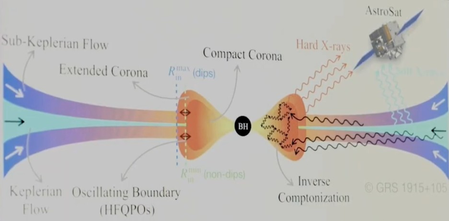
During the brighter phases, when the flickers are strongest, the corona becomes more compact and significantly hotter. In contrast, during the dimmer phases, it expands and cools, causing the flickers to disappear. This clear correlation points to the compact, oscillating corona as the likely source of these fast signals.

While each phase lasted several hundred seconds and repeated in a regular pattern, a rapid flickering signal appeared only during the bright phase. This discovery shows that the corona around the black hole is not a fixed structure and changes its shape and energy depending on how gases flow into the black hole.

The research provides a deeper understanding of the extreme gravitational intensity and high temperature that exist near a black hole’s edge. These findings also improve our models of how black holes grow, release energy, and affect their surroundings.

It also offers clues to how black holes may influence the evolution of entire galaxies.

–IANS

rvt/

Add us to Google Preferred Sources
Indian Community Editorial Team

The Indian Community Editorial Team curates, verifies, and publishes stories that matter to Indians worldwide. From culture and community to business and innovation, our mission is to spotlight voices, ideas, and events that bring our global community closer together. Have news or a story to share? Submit it to us at [email protected].

Add A Comment
find baby names

Coinbase Announces Layoffs Amid AI-Driven Restructuring

May 5, 2026

Madhya Pradesh Government Establishes State-Level Trade Welfare Board

May 5, 2026

Several Countries Condemn Iran’s Attack on UAE

May 5, 2026

Pakistan Struggles with Mounting Debt Issues, IMF Raises Concerns

May 5, 2026
  • Facebook
  • Twitter
  • Pinterest
  • Instagram
About Us
  • About Us
  • Contact Us
  • Terms of Service
Corporate
  • Download Indian Community App
  • Advertise Here
Facebook X (Twitter) Instagram
  • About Us
  • Contact Us
  • Terms of Service
© 2026 Designed by CreativeMerchants.

Type above and press Enter to search. Press Esc to cancel.