


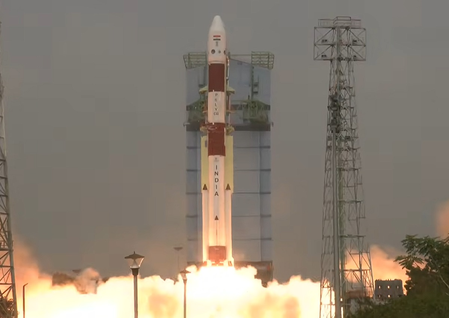
The Indian Space Research Organisation (ISRO) successfully launched the EOS-N1 Earth observation satellite on its PSLV-C62 rocket. The satellite, also known as Anwesha, took off from the First Launch Pad at the Satish Dhawan Space Centre, Sriharikota. This launch marks ISRO’s first mission of 2026 and the 64th flight of the Polar Satellite Launch Vehicle (PSLV).
The primary goal of this mission is to enhance India’s remote sensing capabilities, particularly in areas such as agriculture, urban mapping, and environmental monitoring. The EOS-N1 mission includes the deployment of 15 co-passenger satellites and is scheduled to be placed into Sun Synchronous Orbit. Additionally, the mission features the demonstration of the Kestrel Initial Technology Demonstrator (KID) from a Spanish startup, serving as a prototype re-entry vehicle.
The KID capsule, part of the mission, is set to follow a re-entry trajectory and is expected to splash down in the South Pacific Ocean after being injected into orbit. This launch, known as PSLV-C62 / EOS-N1 Mission, is the 9th dedicated commercial mission by NewSpace India Limited (NSIL), ISRO’s commercial arm. It is also the fifth mission to utilize the PSLV-DL variant with two solid strap-on motors.
ISRO’s PSLV has a rich history, having completed 63 flights, including significant missions like Chandrayaan-1, Mars Orbiter Mission, Aditya-L1, and Astrosat Mission. Notably, in 2017, PSLV set a world record by launching 104 satellites in a single mission. The agency’s previous launch, the 101st mission with PSLV-C61, faced a technical anomaly in the rocket’s third stage, preventing it from reaching the intended orbit.
