


Jordan, Kuwait, and Bahrain experienced new Iranian attacks as tensions between the US and Iran spilled over into neighboring nations in the Middle East. Jordan’s air defenses intercepted three missiles launched from Iran towards Jordanian territory, with a fourth missile falling in a remote area in southern Jordan without causing harm. The missiles were targeting US military aircraft stationed in Aqaba, a city bordering Eilat in Israel.
Israel’s Channel 13 News reported that the US military evacuated refueling aircraft from Ramon Airport in southern Israel following the missile launches towards Jordan. Commercial passenger flights at the airport were also delayed due to the incident. Additionally, the US Embassy in Amman issued a security alert evacuating Aqaba’s airport and seaport due to a specific threat, although Jordanian authorities later confirmed that both facilities were operating normally.
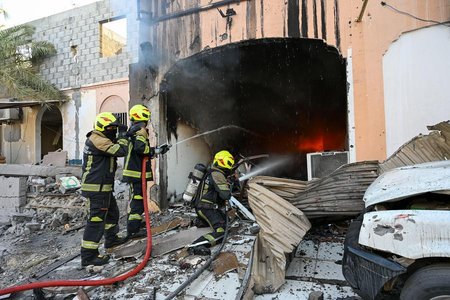
In Kuwait, the Armed Forces announced that they intercepted hostile ballistic missiles and drones, with one attack causing fires and extensive damage to a power generation and water desalination facility. The Kuwaiti Army stated that the incoming missiles and drones were engaged since dawn, without specifying the exact number of projectiles. They accused Iran of targeting civilian and vital infrastructure, including facilities operated by the Ministry of Electricity, Water, and Renewable Energy.
Bahrain also reported intercepting several Iranian aerial attacks through its air defenses. These incidents have raised concerns across the region, leading to renewed calls for restraint. Arab League Secretary-General Nabil Fahmy warned about the severe consequences of escalating tensions, urging the US and Iran to de-escalate immediately to prevent further losses on all sides. He emphasized the risk of a situation spiraling out of control, potentially resulting in mutual destruction and worsening economic conditions in the region and beyond.
Jordan’s Deputy Prime Minister and Minister of Foreign Affairs and Expatriates Ayman Safadi engaged in discussions with Turkish and Kuwaiti counterparts to address the regional escalation and restore stability. Safadi emphasized the importance of ending the escalation, implementing the US-Iran ceasefire agreement, and returning to negotiations for a comprehensive solution to address the root causes of tensions. He also expressed solidarity with Kuwait and other Gulf Cooperation Council countries in the face of Iranian attacks, highlighting the significance of dialogue and diplomacy to resolve the crisis and achieve lasting security and stability.
The recent events occurred amidst heightened tensions in the Middle East, marked by exchanges of attacks between the US and Iran. The United States conducted multiple strikes on Iranian targets, while Iran retaliated by targeting US bases and facilities in various regional countries.
