


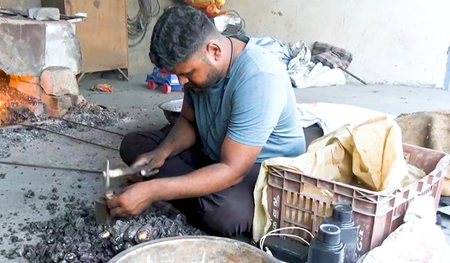
After being granted the Geographical Indication (GI) tag, Kachchh’s copper bell craft is garnering attention globally, leading to increased demand in India and abroad, thereby empowering artisans.
In Jhura village, a significant center for crafting copper bells in the district, artisans have upheld this traditional craft across generations. These bells consist of three main parts – body, cap, and handle, crafted initially from iron scrap, then coated with copper or brass, and finally shaped by artisans.
Artisan Abhishek Lohar explained the process, stating that the bell is formed in three parts – body, cap, and handle, with the initial shaping done using an iron sheet. Following this, the bell undergoes coating, primarily handled by women, and is then fired in a furnace before returning for the final sound creation process and eventual export.
Copper bells, available in various sizes, serve as a testament to Kachchh’s ancient craft legacy. Once primarily used for cattle, they are now in high demand as decorative pieces. Artisan Javed Abdullah mentioned producing bells in a range of sizes, with engraved bells being the most sought-after, especially for cattle.
Government initiatives like Garvi Gurjari and handicraft promotion programs in Gujarat have significantly contributed to the promotion of this centuries-old craft. Artisans have noted the positive impact of government schemes, including access to loans and workshops, which have enhanced marketing efforts and led to increased wholesale orders.
