


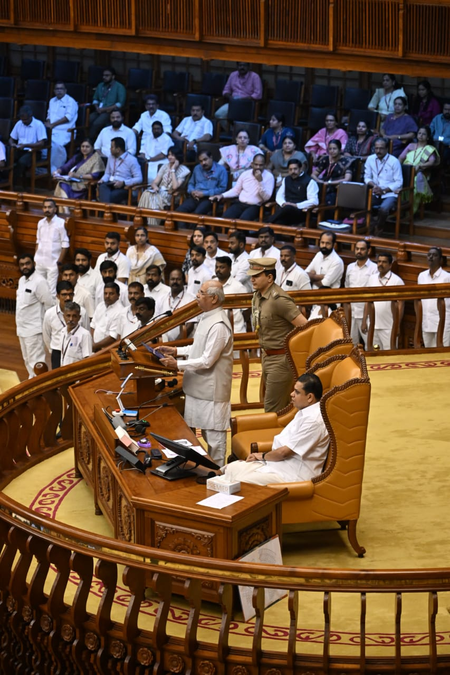
Chief Minister Pinarayi Vijayan expressed worry about alterations made by Governor Rajendra Arlekar to the policy address presented to the Kerala Assembly. The CM highlighted that certain sections in the approved address had been modified or left out, emphasizing the significance of the official policy address sanctioned by the Council of Ministers as the definitive version.
Vijayan pointed out that crucial portions in clauses 12, 15, and 16 were impacted by the deletions. Notably, Clause 12, which acknowledged Kerala’s financial strain due to Union government actions affecting fiscal federalism, was excluded. Additionally, the concluding sentences of Clause 15, focusing on pending state bills and the government’s stance before the Supreme Court and Constitution Bench, were deleted. Meanwhile, Clause 16, addressing states’ constitutional rights over tax revenues and Finance Commission grants, was preserved with the Governor’s inclusion of the phrase “my government believes.”
The CM underscored that as per Article 176, the Governor presents the government’s policy statement to the Assembly at the year’s initial session, with the Cabinet-approved version being the authoritative one, as confirmed by several Chair rulings. He urged the Assembly to formally recognize the Cabinet-approved policy address as the official document.
Supporting the Chief Minister, Speaker A.N. Shamseer echoed the importance of adhering to the Cabinet-approved version, stating that any deviation from the approved content contradicts convention. He assured that the Cabinet-sanctioned version would be shared with members and the media. Former Goa Governor and senior BJP leader P.S. Sreedharan Pillai commented on the incident, expressing concern over the treatment of Governors in such situations, citing similar occurrences in Tamil Nadu and Kerala.
The incident has sparked discussions on Centre-State relations, the role of Governors as per the constitution, and legislative traditions. Analysts suggest that such modifications could escalate tensions before elections, emphasizing the delicate balance between the ceremonial duties of Governors and the executive powers of an elected government.
