


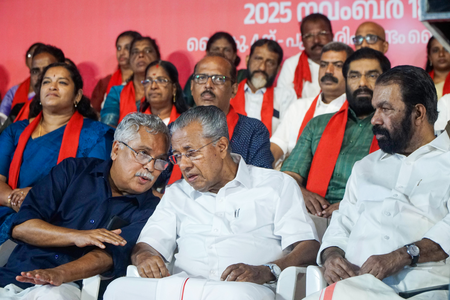
With Kerala eagerly awaiting the May 4 vote counting day, the focus shifts to Chief Minister Pinarayi Vijayan’s decade-long precedents. If Vijayan secures a rare third term, continuity seems likely. However, if power shifts to the Indian National Congress-led UDF, attention will turn to whether the criticized precedents become acceptable governance tools.
One notable change was scrapping the traditional Wednesday post-cabinet media briefing, replacing it with more controlled communication. Vijayan’s approach of avoiding frequent “sound bites” was seen as discipline by supporters but criticized as opacity by opponents. The question arises whether a Congress chief minister adopting a similar approach would face similar criticism.
Another contrast lies in travel habits. Former Chief Minister Oommen Chandy avoided frequent foreign trips, while Vijayan actively pursued overseas visits for investment purposes. The use of helicopters for intra-state travel, a practice initiated by Vijayan, has drawn criticism for its cost. The real test would be how such practices are perceived if adopted by a non-Left chief minister.
Opposition Leader V.D. Satheesan hinted at a different approach, promising more media interactions under a UDF regime. The evolving political landscape in Kerala suggests that governance strategies, once associated with the CPI(M), may face different scrutiny under a Congress-led government. As Kerala awaits the outcome, the impact of power transitions on governance practices remains a key point of interest.
