


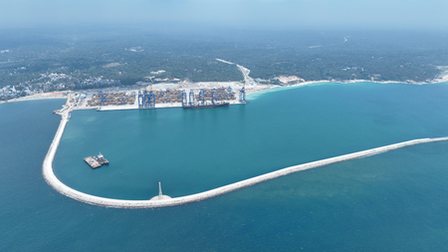
Kerala is advancing its maritime goals by commencing the Phase-2 construction of Adani Group’s Vizhinjam International Deepwater Seaport. This move aims to establish the port as India’s primary transshipment hub. The project, valued at Rs 9,700 crore, will be inaugurated by Chief Minister Pinarayi Vijayan, with Union Minister Sarbananda Sonowal attending as the chief guest.
The expansion program signifies a significant enhancement in capacity, infrastructure, and global competitiveness for Vizhinjam. Under Phase-2, the port’s container handling capacity will increase five times, from one million TEUs to five million TEUs annually. Additionally, the berth length will extend from 800 meters to 2,000 meters, and the breakwater will stretch to four kilometers to accommodate multiple ultra-large container vessels simultaneously.
Vizhinjam is poised to become India’s largest straight-berth port upon completion of Phase-2, capable of hosting four mother ships concurrently. The upcoming infrastructure includes a railway yard, a multi-purpose berth, a liquid terminal, and a tank farm. The liquid terminal is expected to provide Vizhinjam a competitive advantage by enabling large vessels to refuel during extended international voyages.
The port’s strategic location near major East-West shipping lanes is anticipated to attract substantial additional traffic and generate significant tax revenues for Kerala. Notably, the Phase-2 expansion will not necessitate additional land acquisition, with around 55 hectares to be created through sea reclamation. The container yard capacity will rise from 35,000 units to 1,00,000 units, with the total number of cranes set to increase to 100, including 30 ship-to-shore cranes.
Minister Vasavan highlighted Vizhinjam’s early operational success, having handled over 15 lakh TEUs from 710 vessels and established direct services to ports worldwide. Originally scheduled for completion by 2045, the port’s full development is now aimed for 2028 following a supplementary concessionaire agreement signed in 2023. The expansion into Phase-2 is expected to boost logistics, employment, and trade activities across southern India.
