


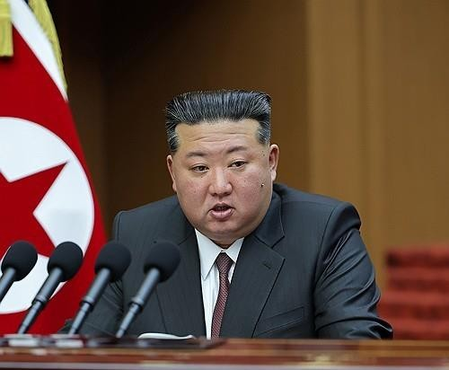
North Korean leader Kim Jong-un has officially labeled South Korea as the “most hostile state” and cautioned of severe repercussions if provoked by Seoul. Kim emphasized North Korea’s nuclear status while addressing the first session of the newly elected 15th Supreme People’s Assembly. He stated that the North’s constitution was revised to align with national development demands.
Kim’s remarks, reported by the Korean Central News Agency, indicated that North Korea will completely ignore and dismiss South Korea. Any provocative actions by Seoul were warned to face “merciless” consequences from North Korea. The discussion of revising North Korea’s constitution raised questions about the formal recognition of South Korea as a hostile state.
The North Korean constitution historically aimed for peaceful reunification with South Korea. However, recent amendments following Kim’s directive in 2024 have increasingly portrayed Seoul as the primary hostile country. North Korea’s stance towards Seoul has become notably antagonistic, ruling out possibilities of inter-Korean engagement.
Kim also criticized the United States for alleged terrorist activities worldwide, without directly mentioning President Donald Trump. He emphasized the importance of a powerful defense for a country’s dignity and interests. Kim pledged to enhance North Korea’s defensive nuclear capabilities and maintain a swift response posture against strategic threats.
In a parliamentary session in 2022, North Korea enacted a nuclear law allowing preemptive nuclear weapon use, solidifying its status as a nuclear state. Experts suggest that North Korea’s constitutional revision may have codified the new definition of Seoul, maintaining strategic ambiguity. Analysts view Kim’s recognition of Seoul as the most hostile state as a potential shift in fundamental norms.
At the recent parliamentary meeting, North Korea increased this year’s state budget by 5.8%, the largest rise in recent years. Kim aims to ensure the country’s normal operation and policy implementation by boosting state revenues. South Korea’s unification ministry noted Kim’s readiness for both confrontation and peaceful coexistence, signaling a nuanced critique of Washington.
