


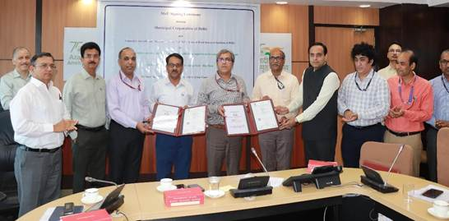
The Municipal Corporation of Delhi (MCD) has partnered with CSIR-Central Road Research Institute (CSIR-CRRI) to introduce new technology for instant pothole repair, road evaluation, construction quality supervision, and staff training. MCD Commissioner Sanjeev Khirwar stressed the significance of technology-driven solutions in urban road management, aiming to enhance the agency’s technical capabilities through this collaboration.
At an event, a Technology Management Agreement was signed to implement ECOFIX, a technology for instant pothole repair based on iron and steel slag aggregates developed by CSIR-CRRI. The partnership focuses on improving the quality, durability, and sustainability of Delhi’s road infrastructure by employing scientific road assessment, quality assurance, and innovative maintenance technologies, as stated by Khirwar.
Ravi Sekhar, Director of CSIR-CRRI, highlighted the Institute’s extensive contributions to the road sector over seven decades and expressed that the collaboration would offer technical assistance to MCD in road evaluation, quality supervision, and the use of sustainable technologies. Various technologies like Steel Slag Road Technology, ECOFIX, Rejupave, and MSS+ are aimed at promoting resource conservation, circular economy principles, and reduced carbon emissions.
The initiative, spearheaded by Satish Pandey, Head of Flexible Pavement Division at CSIR-CRRI and the inventor of Steel Slag Road and ECOFIX Technology, focuses on enhancing road serviceability, durability, and lifecycle performance while minimizing maintenance disruptions. ECOFIX, a quick and long-lasting pothole repair solution utilizing processed iron and steel slag aggregates, aligns with the national waste-to-wealth vision by utilizing industrial by-products for sustainable road maintenance, thereby improving durability and reducing environmental impact, such as air pollution.
Improved road conditions and timely maintenance are expected to decrease road dust generation, while the use of steel slag and recycling-based technologies supports the conservation of natural resources and circular economy practices, according to an official statement.
