


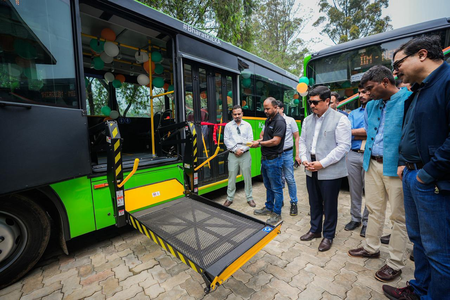
Meghalaya Chief Minister Conrad K. Sangma initiated five electric buses as part of the PM eBus Sewa Scheme to enhance sustainable urban mobility and cleaner public transportation in the state. The launch took place at Taraghar, State Guest House in Shillong. These electric buses are integral to the strategy aimed at easing congestion in the state capital, reducing carbon emissions, and enhancing public transport infrastructure.
The newly introduced air-conditioned electric buses are eco-friendly, emitting zero emissions, and can travel approximately 180-200 km on a single charge. Each bus has a capacity for 25 passengers and is equipped with wheelchair spaces, foldable ramps, GPS monitoring, and e-ticketing facilities. Chief Minister Sangma highlighted the long-standing challenges faced by Shillong in public transportation and traffic congestion, emphasizing the government’s commitment to finding solutions for improved urban mobility.
The electric bus initiative is part of a broader vision that includes expanding parking infrastructure, promoting public transport, and developing an administrative city at Mawdiangdiang to alleviate pressure on Shillong’s urban core. Chief Minister Sangma stressed the importance of decongesting Shillong and encouraging the use of public transportation over private vehicles. He also announced the renewal of the state’s policy offering exemptions on registration fees and road taxes for electric vehicles upon Cabinet approval.
Encouraging the wider adoption of electric vehicles, Chief Minister Sangma noted their suitability for Meghalaya’s hilly terrain and the convenience of charging them at home. State Urban Affairs Department Commissioner and Secretary Vijay Kumar D disclosed that Shillong has been granted 50 electric buses under the PM eBus Sewa Scheme. The city is implementing a Gross Cost Contract (GCC) model, compensating operators based on service quality and schedule adherence rather than passenger fares.
According to officials, the city has witnessed a significant increase in daily ridership from about 300 passengers to nearly 3,000 passengers within a few months with the operation of 15 diesel buses under the same model. The state government anticipates a combined fleet of around 150 diesel and electric buses within six months, capable of serving approximately 60,000 commuters daily in Shillong.
