


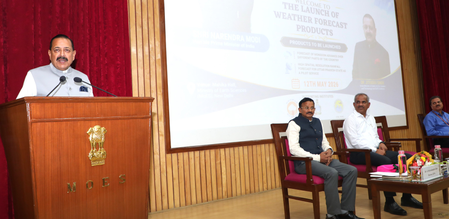
The Ministry of Earth Sciences introduced two new weather forecast products aimed at delivering hyper-local, impact-based, and AI-driven weather services nationwide. These products, launched by Union MoS Science & Technology, Earth Sciences Dr. Jitendra Singh, include the first-ever Artificial Intelligence (AI) driven system by the India Meteorological Department (IMD). The systems represent a significant shift towards impact-based and decision-support forecasting, offering precise, location-specific, and actionable information to farmers, administrators, disaster managers, and citizens.
The newly developed systems are a collaborative effort involving the India Meteorological Department (IMD), Indian Institute of Tropical Meteorology (IITM), Pune, and National Centre for Medium Range Weather Forecasting (NCMRWF). Dr. Singh highlighted that the AI-enabled monsoon advance forecasting system will provide probabilistic forecasts of monsoon progression every Wednesday up to four weeks in advance. These forecasts are designed to support farmers across 16 States and more than 3,000 sub-districts through the Ministry of Agriculture and Farmers’ Welfare’s dissemination framework.
One of the products, the High Spatial Resolution Rainfall Forecast for Uttar Pradesh, has been created as a pilot service to generate rainfall forecasts at a 1-km spatial resolution up to 10 days in advance. This system utilizes advanced AI-driven downscaling techniques and integrates data from Automatic Rain Gauges (ARGs), Automatic Weather Stations (AWSs), Doppler Weather Radars, and satellite-based rainfall datasets. The service is expected to benefit various sectors including agriculture, water resources, renewable energy, urban planning, disaster management, and infrastructure.
Farmers will now have access to more detailed information for making informed decisions related to sowing, irrigation, crop protection, and harvest planning with enhanced local precision. Dr. Singh emphasized the significant advancements in India’s weather forecasting capabilities over the past decade, attributing the improvements to technology, data integration, and advanced modeling that have notably enhanced forecast accuracy and public trust in IMD services.
