


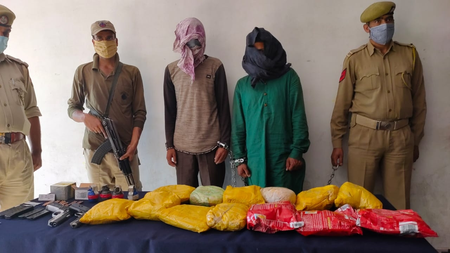
Investigating agencies in Jammu and Kashmir are actively addressing the rise in narcotics cases, with syndicates from Pakistan identified as the primary drug suppliers to the region. Exploiting vulnerabilities along the border areas, these syndicates have been smuggling drugs into the Union Territory, often using Punjab as a transit point before transporting them to J&K by road.
In 2025, the Jammu and Kashmir police conducted a significant crackdown on narcotics-related activities, resulting in the registration of over 1,000 cases under the Narcotics Drugs and Psychotropic Substances (NDPS) Act. During the same period, approximately 1,400 arrests were made, including several major drug suppliers and peddlers.
A notable trend observed during the crackdown was the increasing involvement of women and couples in the drug trade. In Jammu alone, 35 women were arrested, with evidence pointing to the operation of all-woman networks to avoid detection by law enforcement authorities.
The emergence of all-women networks in the drug trade is believed to be influenced by the ISI’s strategy to promote similar setups within terrorist organizations like Jaish-e-Mohammed and Lashkar-e-Taiba in Jammu and Kashmir. This tactic aims to make detection more challenging for authorities, with the use of couples and women providing a cover that slows down identification processes.
Authorities noted a shift in strategy by drug syndicates to include all-women networks and couples in their operations, making detection more difficult. The use of couples offers a familial cover, while women, like Dr. Shaheed Saeed from the Faridabad module, have been instrumental in evading detection due to their roles as recruiters and facilitators in the drug trade.
Intelligence reports suggest that the ISI’s strategy of involving women in illicit activities, including drug trafficking and terrorism, has proven effective in evading detection and enhancing recruitment efforts. The ease with which women can recruit individuals, especially youth, has made them valuable assets in expanding illicit networks.
To counter the influx of drugs from Pakistan, authorities are focusing on preventing the flow of narcotics into Jammu and Kashmir. The use of drones for smuggling has increased significantly, with 791 drone incursions reported in 2025 along the western border, primarily in Punjab and Rajasthan, with minimal activity in Jammu and Kashmir.
Intelligence agencies anticipate a rise in narcotics smuggling, driven by Pakistan’s need for funds to sustain terrorist activities. With actionable intelligence pointing to increased drug trafficking and the proliferation of all-women narco modules, authorities remain vigilant to combat this growing threat.
