


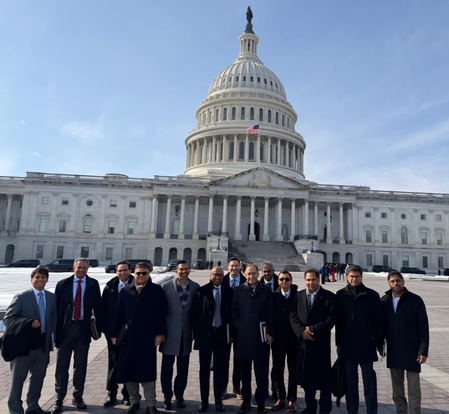
The Nasscom US CEO Forum recently convened for its first industry engagement following the India-US trade deal announcement. Held at Capitol Hill in Washington, DC, the meeting gathered Indian technology business leaders and senior US policymakers. Discussions focused on fostering innovation, AI, trusted supply chains, workforce development, and local job creation in the US.
Rajesh Nambiar, President of Nasscom, highlighted the significance of the India-US trade deal in ensuring macro predictability amid global competitiveness driven by technology, talent, and trust. He emphasized the positive impact of Indian technology companies on the US economy, citing the creation of high-quality jobs, regional investments, and significant innovation.
The Forum aims to transition the partnership from collaboration to co-creation, emphasizing data-driven strategies, accountability, and long-term value creation. Participants explored opportunities for deeper collaboration in AI across the value chain, aligning with the Pax Silica coalition spearheaded by the US.
Indian technology firms are well-positioned to play a pivotal role in the global AI landscape, particularly in enterprise applications, consulting services, silicon design, and advanced platforms. This collaboration is expected to benefit Fortune 500 companies and drive job creation across various US states, with a joint trade target of $500 billion between India and the US.
Energy security emerged as a key focus area, with the US enhancing AI-critical energy capacity and India integrating green and nuclear energy for next-gen data centers. Indian tech companies are actively contributing to AI-driven energy optimization, grid analytics, and digital infrastructure, bolstering the US innovation ecosystem.
Amit Chadha, CEO & MD of L&T Technology Services and Vice Chair of Nasscom US CEO Forum, emphasized the potential for a trusted technology alliance between India and the US. He highlighted the integral role of Indian tech firms in supporting Fortune 500 enterprises and driving local job creation across US states. The aim is to contribute to the bilateral trade target of $500 billion, fostering innovation-driven growth for both economies.
