


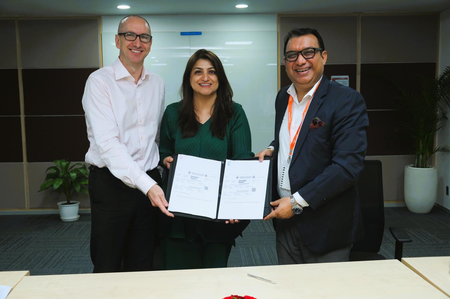
Global Capability Centre (GCC) NatWest Group has announced a partnership with the Indian Institute of Technology Delhi, facilitated by its Foundation for Innovation and Technology Transfer (FITT). This collaboration aims to enhance the connection between industry and academia through research and pilot projects. The partnership will explore joint innovation programs, pilot initiatives, and industry-led research in areas such as Artificial Intelligence, Fintech, cybersecurity, and other emerging technologies.
This partnership marks FITT’s first collaboration with a global bank and is expected to foster stronger collaboration through joint programs involving researchers, startups, and students. The focus will be on applying academic research to real business challenges, providing opportunities for NatWest colleagues and students to contribute to new ideas and research that benefit customers.
Scott Marcar, Chief Information Officer at NatWest Group, emphasized the significance of working with esteemed institutions like IIT Delhi in shaping the future technology landscape and driving innovation. He highlighted that such collaborations are essential for evolving continuously, simplifying banking processes, enhancing security, and improving customer experiences.
Ruchika Panesar, Country Head, India, and Chief Digital and Information Officer, Group Functions at NatWest Group, underscored India’s pivotal role in the bank’s technological advancements and future growth. She mentioned that partnerships with institutions like IIT Delhi are instrumental in strengthening the talent pool and fostering deeper engagement with the academic and startup ecosystem. These collaborations accelerate innovation in various domains, including customer experiences, technology, data, and AI.
Dr. Nikhil Aggarwal from FITT-IIT, Delhi, expressed that the partnership signifies a robust model of industry-academia collaboration. This model aims to transition innovation from laboratories to scalable solutions while nurturing talent capable of addressing complex global challenges.
