


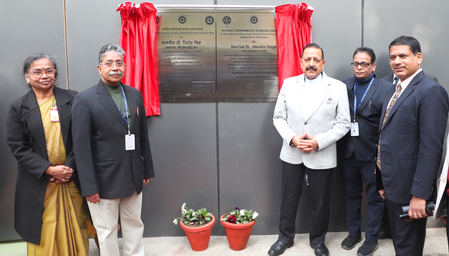
India’s CSIR-National Physical Laboratory (NPL) has launched the world’s second National Environmental Standard Laboratory and the fifth National Primary Standard Facility for Solar Cell Calibration. These facilities, inaugurated during the 80th Foundation Day celebrations of CSIR-NPL, aim to bolster India’s environmental and renewable energy sectors. The National Environmental Standard Laboratory is seen as a crucial move to enhance India’s environmental governance framework.
The National Environmental Standard Laboratory will provide India-specific calibration and certification for air pollution monitoring systems, ensuring transparent and accurate environmental data. This will benefit regulatory bodies, industries, and startups by testing monitoring instruments under Indian climatic conditions, thus aiding policy enforcement like the National Clean Air Programme. The Solar Energy Complex, developed in collaboration with PTB, Germany, is a cutting-edge facility that positions India as a global leader in photovoltaic measurement standards.
The Solar Energy Complex features a laser-based Differential Spectral Responsivity system that achieves the lowest uncertainty globally for reference solar cell calibration. This facility is expected to reduce India’s reliance on foreign certification agencies, save foreign exchange, expedite calibration processes, and boost investor confidence in the country’s expanding solar sector. Union Minister of State for Science & Technology emphasized that science and technology advancements will play a pivotal role in shaping India’s socio-economic future.
Describing CSIR-NPL as a symbol of India’s scientific evolution from pre-Independence to global technological leadership, the Minister highlighted its historical significance. The laboratory, operational even before Independence, has been a cornerstone of India’s scientific progress post-Independence. The Minister underscored the role of CSIR-NPL in establishing Indian Standard Time (IST) and its historical association with eminent national leaders like Dr. Syama Prasad Mukherjee and Sardar Vallabhbhai Patel. Indian scientists, according to the Minister, are now integral to national aspirations, moving beyond isolated laboratory work to meet broader societal expectations.
