


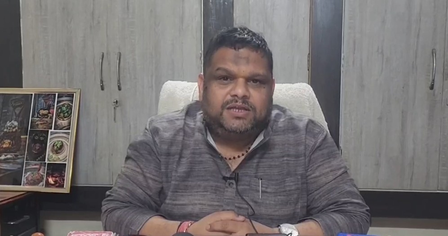
National Human Rights Commission (NHRC) member Priyank Kanoongo has expressed satisfaction with the Madhya Pradesh High Court’s decision declaring the Kamal Maula Mosque, also known as Bhojshala, a temple. This ruling has sparked optimism for the restoration of the ancient Vijay Surya Mandir in Vidisha.
The Madhya Pradesh High Court’s Indore Bench recently redefined the legal status of the Bhojshala complex in Dhar, affirming it as a temple with continuous historical Hindu worship rights. The judgment, delivered by Justice Vijay Kumar Shukla and Justice Alok Awasthi, overturned decades of administrative arrangements and compromises related to the disputed site.
Priyank Kanoongo, in response to the verdict, highlighted the cultural resurgence in India and drew parallels with significant religious events in the nation. He emphasized the importance of reconnecting with India’s historical and cultural heritage, citing the construction of the Ram Temple in Ayodhya by Prime Minister Narendra Modi as a pivotal moment.
The ruling on Bhojshala has reignited discussions on the Vijay Surya Mandir in Vidisha, a site where Hindus traditionally gather for prayers during Nag Panchami outside locked gates. The dispute over the structure’s identity has persisted, with conflicting views from the Archaeological Survey of India (ASI) and local Hindu groups regarding its historical and legal standing.
Priyank Kanoongo’s remarks have underscored the aspirations for recognizing the historical identity of the Vijay Surya Mandir in Vidisha. The ongoing debate, fueled by demands for a detailed archaeological survey of the site, reflects the broader discourse on temple-mosque disputes and the need for clarity on the historical context of religious monuments.
The Bhojshala verdict is seen as a significant legal milestone that could influence future deliberations on contested religious sites across India. It has sparked hope among various groups for a reevaluation of similar disputes and a deeper examination of the historical and legal aspects of religious structures.
