


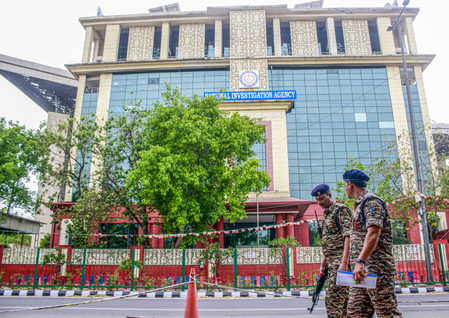
The National Investigation Agency (NIA) is focusing on the angle of ‘cyber-instigation’ in the violence that occurred in Murshidabad district’s Beldanga area. The investigation stems from the death of a migrant worker from West Bengal in Jharkhand, which led to misleading and provoking local people through social media messages. NIA officials are examining digital footprints of social media accounts to trace the source of controversial posts that falsely portrayed a suicide as a murder.
Sources reveal that NIA sleuths have collected information from the cyber-crime police station at Baharampur and are scrutinizing messages sent from various social media accounts before the outbreak of violence in Beldanga. The agency suspects that these controversial posts played a crucial role in inciting a section of the community to take law into their own hands by misrepresenting the migrant worker’s death.
The NIA is also investigating whether there was an organized effort behind the dissemination of these controversial posts to incite violence in West Bengal. The focus of the probe is to determine if the sentiments of the local population were aggravated by these posts following the migrant worker’s tragic demise in Jharkhand. The violent protests in Murshidabad’s Beldanga on January 16 resulted in disruptions to traffic movement on National Highway 12.
The protests, which saw people blocking railway tracks and attacking law enforcement and media personnel, continued for a second day. Subsequently, a Public Interest Litigation (PIL) was filed at the Calcutta High Court, urging the deployment of central forces in Beldanga and an NIA investigation into the matter. Following the PIL, the Union Ministry of Home Affairs authorized the NIA to commence the probe into the violence and unrest in Beldanga.
