


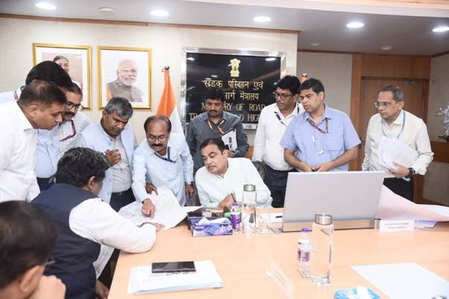
Union Road Transport and Highways Minister Nitin Gadkari recently assessed proposed high-speed and high-density corridors along with other significant national highway projects in Maharashtra. The review meeting in the national capital covered various projects, including the six-laning of the Nagpur–Bhandara section, four-laning of the Taloda–Burhanpur section, and corridors like Durg–Gadchiroli–Mancherial, Gadchiroli–Kanker (Raipur–Visakhapatnam), Gwalior–Nagpur, and Nagpur–Hyderabad.
Discussions also revolved around projects such as the Bhandara–Raipur section, Lakhnadon–Durg–Raipur corridor, Nagpur–Amravati section, and the NH-44 stretch from Madhya Pradesh–Maharashtra Border to Borkhedi. Additionally, the meeting addressed nine state build-operate-transfer projects covering 527 km on NH stretches in Maharashtra, aiming to enhance road connectivity and boost economic development in the region.
The focus of the review was on expediting project planning and execution to reinforce road connectivity and promote economic growth in the area. India’s road network has significantly expanded over the past decade, making it the world’s second-largest, with national highways stretching over 1,46,560 km. The government has constructed 57,125 km of national highways in the last five years, averaging 34,215 lane-km annually, leading to substantial employment generation.
The surge in construction has resulted in a 61% increase in the National Highway network from 91,287 km in 2014 to 1,46,560 km in 2025. Moreover, the operational access-controlled high-speed corridors and expressways have grown from 93 km in 2014 to 3,052 km by the end of 2025.
