


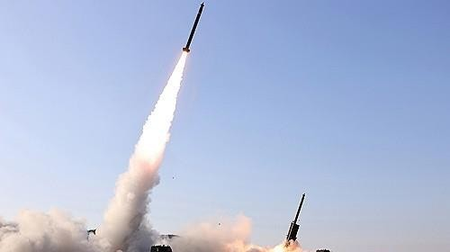
North Korea conducted a test of an upgraded large-caliber multiple rocket launcher system under the supervision of leader Kim Jong-un, as reported by state media. Kim emphasized the test’s importance in enhancing their strategic deterrent capabilities and mentioned the potential for specific attacks using this weapon system. The upcoming ruling party congress is expected to outline plans for strengthening the country’s nuclear deterrent, according to the Korean Central News Agency.
The recent weapons test follows South Korea’s detection of multiple short-range ballistic missiles launched from North Korea towards the East Sea. Kim highlighted improvements in the rocket launcher system’s strike capability, mobility, intelligence, and accuracy, emphasizing the continuous enhancement of their defense technology. The test is seen as part of efforts to enhance the country’s deterrent against nuclear war, with a focus on building a reliable offensive capability.
Photos released from the test showed Kim’s daughter Ju-ae present alongside Kim Jong-sik and Jang Chang-ha, key officials from the party’s Central Committee and Missile Administration, respectively. The missile launch is viewed as a demonstration of strength ahead of North Korea’s upcoming ninth congress, where five-year development plans for defense and the economy are expected to be unveiled. The test coincided with discussions on security matters, including South Korea’s nuclear-powered submarine plans, during a visit by US Under Secretary of Defense for Policy Elbridge Colby.
Experts suggest that the rocket launcher’s self-steered precisely guided flight system may incorporate new navigation technology to counter GPS jamming. Speculations include the potential use of a military-grade GPS system from Russia, known for its immunity to jamming operations. Analysts also point out that Kim’s reference to the system’s applicability for specific attacks could imply the inclusion of tactical nuclear weapons. North Korea’s rocket launchers with a 600-millimeter caliber have a range of up to 400 km, placing key military bases in South Korea within striking distance.
