


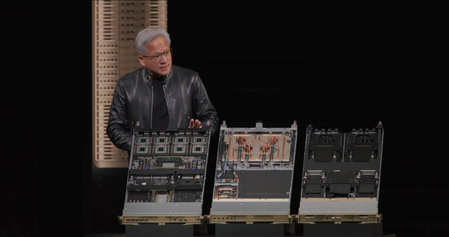
Major chipmaker Nvidia, at its annual GTC event, revealed plans to potentially earn $1 trillion solely from AI chips by 2027. CEO Jensen Huang emphasized Nvidia’s strategy to dominate the AI sector through a comprehensive hardware, software, and infrastructure approach.
Huang highlighted the growing demand for Nvidia’s upcoming AI platforms, predicting a substantial revenue boost. The company introduced the Groq 3 Language Processing Unit to accelerate AI inference workloads, set for release in the third quarter, featuring enhanced speed and efficiency.
Nvidia also unveiled the Vera Rubin Space One computing system, developed for space-based data centers, with a satellite launch planned for this year. Huang emphasized the rise of physical AI, envisioning every industrial firm transitioning into a robotics entity powered by Nvidia’s technology.
In a significant development, Nvidia presented the Kyber rack-scale architecture prototype, designed to enhance compute density and reduce latency with up to 144 GPUs in stacked configurations. The Vera Rubin Ultra system, incorporating this architecture, is expected to launch in 2027.
Regarding automotive partnerships, Nvidia disclosed Uber’s plan to deploy a fleet utilizing Nvidia’s Drive AV software by 2028 in various global cities, starting with Los Angeles and San Francisco. Huang also mentioned collaborations with automakers like Nissan, BYD, Geely, Isuzu, and Hyundai on Level 4 autonomous vehicles using Nvidia’s Drive Hyperion platform.
