


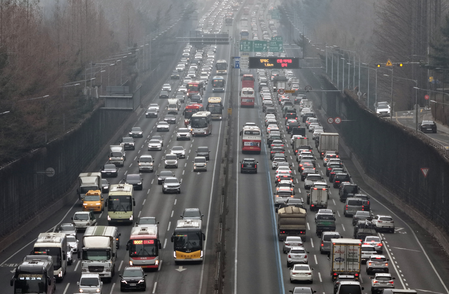
Outbound traffic congestion is anticipated to reach its peak on Sunday as more individuals travel to their hometowns for the Lunar New Year holiday. The holiday, known as Seol, is set to be celebrated on Tuesday, with the festive period spanning from the weekend through Wednesday, as per Yonhap news agency. Traffic congestion caused by outbound vehicles is projected to be most severe between noon and 1 p.m., gradually easing around 8 to 9 p.m., according to the state-run Korea Expressway Corp.
As of 8 a.m., the journey from Seoul to Busan, approximately 330 kilometers away, is estimated to take about six hours and 10 minutes. Similarly, traveling to Daegu, situated some 240 km southeast of Seoul, is expected to require 5 hours and 10 minutes. On the return route towards Seoul, travel times are comparatively shorter, with a trip from Busan to Seoul taking 5 hours and 10 minutes, and from Daegu to Seoul taking 4 hours and 10 minutes.
The Korea Expressway Corp. has approximated that around 5 million vehicles will traverse the nation on Sunday, including 450,000 cars departing from the greater Seoul area and 380,000 vehicles heading towards it. Meanwhile, North Korea is observing an extended Lunar New Year holiday this year, coinciding with the national holiday commemorating the late former leader Kim Jong-il’s birthday.
North Korea traditionally observes a one-day Lunar New Year holiday, scheduled for this Tuesday, which is shorter than South Korea’s three-day celebration. This year, the Lunar New Year follows the late leader’s birthday on Monday, providing North Koreans with a three-day holiday. North Koreans typically mark the new year based on the Western calendar, while South Koreans observe the Lunar New Year more elaborately.
North Korea, initially dismissing the traditional Korean holiday as a feudal remnant, reinstated it in 1989 during the Kim Jong-il regime, alongside the Chuseok holiday. The country now utilizes the traditional holiday not only to pay homage to ancestors but also to honor the accomplishments of its late leaders, including state founder Kim Il-sung, and to reinforce loyalty to the current leader, Kim Jong-un. During the Lunar New Year, North Koreans commonly visit the Kumsusan mausoleum in Pyongyang, where the late leaders are enshrined, or their statues nationwide to offer flowers. Restaurants remain operational and bustling with patrons during the holiday period, as travel outside regions or hometowns is restricted and necessitates permission.
