


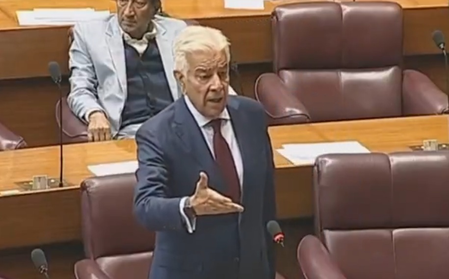
Pakistan’s Defense Minister, Khawaja Asif, recently admitted that Pakistan had been acting as a “hired force” in Afghanistan, marking a significant acknowledgment of policy failure. This statement sheds light on Pakistan’s struggle to come to terms with its past interventions in Afghanistan and its current security challenges.
Asif’s remarks, made in Pakistan’s National Assembly following a suicide attack in Islamabad, highlighted Pakistan’s involvement in Afghan conflicts for over two decades, not out of religious motives but to serve Western interests. He emphasized that Pakistan’s engagement in Afghanistan was primarily aimed at gaining US support rather than driven by ideological beliefs.
The Defense Minister’s confession challenges the long-held narrative that Pakistan’s actions in Afghanistan were motivated by religious obligations and defense of the Muslim world. Instead, it underscores a pragmatic approach driven by geopolitical considerations and strategic alliances.
Former Afghan diplomat Aziz Mareq suggested that Asif’s statements were more about deflecting accountability than accepting responsibility. He pointed out that Pakistan’s actions in Afghanistan were largely motivated by economic interests rather than altruistic intentions.
Asif’s acknowledgment of Pakistan’s role as a “hired force” in Afghanistan reflects growing frustration with the deteriorating relationship between Pakistan and the Taliban. The strained ties between Pakistan and Afghanistan, compounded by mutual distrust and diverging interests, underscore the complex dynamics at play in the region.
Political analysts have noted that Asif’s admission signifies a critical moment in Pakistan’s Afghan policy, revealing internal contradictions and a reluctance to fully acknowledge past mistakes. The ongoing blame game between Pakistan and Afghanistan highlights the deep-rooted challenges in the region’s security landscape.
