


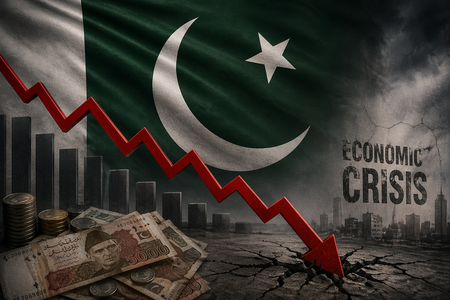
Pakistan’s economy is once again showing vulnerabilities in its external sector due to the ongoing Middle East crisis, as per a report. Despite temporary measures to stabilize the economy, Islamabad has not tackled underlying issues hindering its economic growth. The country is experiencing a resurgence of the current account deficit, especially in the balance of payments, making it highly susceptible to geopolitical risks and commodity price fluctuations.
Foreign direct investment (FDI) in Pakistan has dropped significantly by 31% in the first 10 months of FY26. During July-April FY26, Pakistan received only $1.409 billion in FDI, a decrease from $2.035 billion in the same period the previous fiscal year. Total foreign investment for the same period was just $31.7 million, down from $1.46 billion a year earlier. Investors are cautious due to policy uncertainties, tax complexities, currency fluctuations, and associated risks.
While foreign remittances have helped Pakistan avoid a severe financial crisis, relying solely on them to mask structural weaknesses is not a sustainable long-term strategy. The country needs to implement significant structural reforms to enhance the business environment, improve governance, and address other critical issues for economic resilience.
Another concern arises from Pakistan’s exploration of Panda bonds, which raises worries about increased financial reliance on China. Despite seeking alternative funding sources to manage external pressures, this move could deepen Pakistan’s dependence on Chinese financial systems, according to reports. The issuance of yuan-denominated bonds in China’s domestic market is seen as an effort to diversify funding beyond Western lenders and multilateral institutions but may further tie Pakistan to Chinese financing.
