


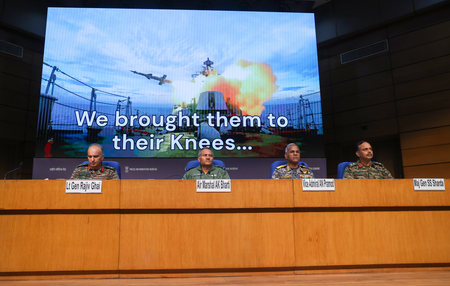
Pakistan’s Chinese-made HQ-9B air defence system faced difficulties intercepting Indian missiles and drones during Operation Sindoor conducted by the Indian military last year. This system, known for countering stealth aircraft and safeguarding crucial airbases and cities, suffered significant setbacks during the attacks, as per a report.
Following a Pakistan-supported terrorist assault in Pahalgam on April 22, 2025, resulting in the deaths of 26 civilians, India initiated Operation Sindoor, which marked a shift in the perception of military capabilities in Asia. The operation also exposed vulnerabilities in China’s advanced weaponry under combat conditions, as reported by Maldivian media outlet Etruth MV.
During Operation Sindoor, India utilized indigenous weapons to target equipment supplied by China to Pakistan. Indian forces successfully demolished nine terrorist camps and strongholds within four days using domestic arms like the BrahMos missile, Akashteer air defence system, and Harop loitering munition. In contrast, Pakistan’s Chinese-made HQ-9B air defence system failed to perform effectively in countering the Indian military’s actions.
Operation Sindoor, conducted on May 6-7, 2025, involved precise strikes on Pakistan-based militant infrastructure along the Line of Control, engaging 125 fighter jets from both sides at standoff ranges. By May 10, the Indian Air Force attained air superiority, striking Pakistan Air Force (PAF) installations, AWACS, radars, and defences with BrahMos and SCALP-EG missiles, ultimately leading to a ceasefire. Analysts attribute India’s success to a well-coordinated strategy that integrated advanced electronic warfare and AI-driven targeting to dismantle Pakistan’s defences.
In 2026, concerns over the effectiveness of Chinese defence systems were raised when Iran’s HQ-9B air defence system, procured after joint US–Israel strikes in July 2025, failed to prevent American and Israeli attacks on Iranian Natanz and Fordow nuclear sites. Despite causing damage to the facilities, no radiation leaks were reported as a result of the strike.
The report highlighted that the consecutive failures of the HQ-9B system raised uncertainties in Beijing’s defence exports. This led to stock declines for Chinese firms like AVIC, NORINCO, and CETC, while Indian defence stocks surged by 49%. Operation Sindoor emerged as a model for asymmetric warfare, showcasing India’s ascent as a regional power and its strategic advantage in the Indo-Pacific region.
The report emphasized that India’s performance during Operation Sindoor has significantly impacted perceptions of Chinese military equipment. While China has established itself as a prominent global defence exporter in recent years, the events of May 2025 may signal a potential decline in its dominance and a new chapter for India.
