


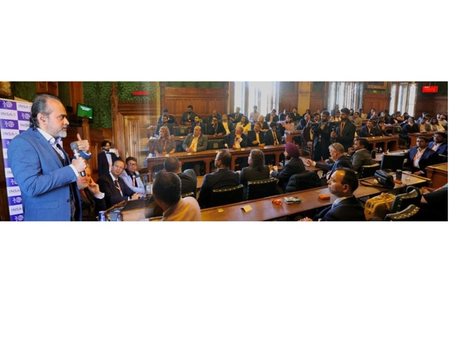
Philosopher and author Acharya Prashant recently addressed a special gathering at the House of Lords in the British Parliament. Speaking on the theme “Indian Roots, Global Wings,” he emphasized the message of Indian philosophy and Vedanta in a global context. Prashant highlighted that true Indianness goes beyond culture, tradition, and festivals, focusing instead on self-knowledge through self-enquiry, asking the fundamental question, “Who am I?”
The event took place within the Palace of Westminster, a venue known for hosting distinguished figures like Queen Elizabeth II and Nelson Mandela. The audience comprised British policymakers, parliamentarians, educators, students, and public representatives from various fields. Notable attendees included Lord Bilimoria, Lord Nagaraju, Barry Gardiner, Indian Deputy High Commissioner Kartik Pande, and Amit Tiwari.
As the Chief Guest, Acharya Prashant shed light on the contemporary and global significance of the Upanishadic verse “Asato Ma Sad Gamaya.” He stressed that Indian roots signify a deep commitment to self-exploration, from which major Indian philosophical streams have emerged, such as Vedanta, Buddha, and Saint Kabir. Prashant emphasized that true freedom comes from recognizing and shedding inner bondages, rather than external achievements.
Delving into the meaning of the Upanishadic prayer “Asato Ma Sad Gamaya, Tamaso Ma Jyotir Gamaya, Mrityor Ma Amritam Gamaya,” Prashant explained its universal call for an inner journey from untruth to truth, darkness to light, and death to the deathless. He also referenced the Katha Upanishad’s directive to “arise, awake, and learn from the wise” and the negation principle of “Neti Neti,” emphasizing the importance of continuous self-enquiry and avoiding fixed identities.
Prashant highlighted that global issues like the climate crisis stem from human beings’ internal disorder rather than external factors. He stressed the need for mass self-education to address crises like climate change, social fragmentation, and mental unrest. Prashant’s address at the British Parliament is part of his broader UK tour, where he aims to tackle global challenges with the philosophy of self-knowledge, emphasizing that India’s true contribution lies in its self-knowledge rather than cultural symbols.
