


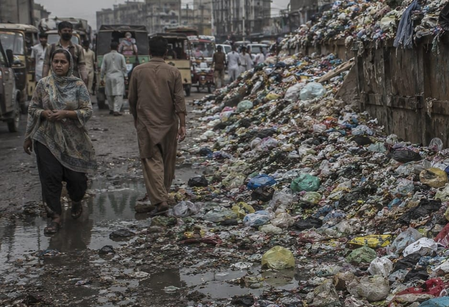
Sanitation conditions in various parts of Karachi, Pakistan, continue to deteriorate post-Eidul Azha, with waste collection vehicles failing to pick up animal waste and household garbage for over a week. The absence of disinfectant spraying and proper waste management has led to foul smells and unhygienic surroundings, raising concerns about the potential spread of diseases. Areas like Pir Colony, FC Area, Liaquatabad No. 4, and others are grappling with severe waste management issues, as reported by Pakistan’s daily The Express Tribune.
Large garbage piles have accumulated in different Karachi neighborhoods, with some areas witnessing what residents describe as ‘mountains of garbage’. Particularly, Pir Colony faces a critical situation where a dumping point for sacrificial animal waste on the main road has exacerbated the problem, compounded by the dumping of routine household waste at the site. Despite some cleanup efforts on the third day of Eid, daily household garbage remains uncollected, contributing to the accumulation of waste in various locations.
Residents in Soldier Bazaar and Garden areas have highlighted that waste collection staff were present only during the initial days of Eid, disappearing thereafter and leaving behind substantial garbage heaps in these localities. Meanwhile, Karachi residents are also grappling with a water crisis as the water supply has been disrupted for the third consecutive day due to a fault in K-Electric’s main cable.
The Karachi Water and Sewerage Corporation (KWSC) reported that power outages at key pumping stations have resulted in an 85 million gallons per day (MGD) water shortfall in the city. The ongoing power failures have exacerbated the water crisis in Karachi, which has been enduring acute water shortages for the past two months. The recent disruptions in water supply have further compounded the challenges faced by residents, particularly amid the prevailing hot weather conditions.
