


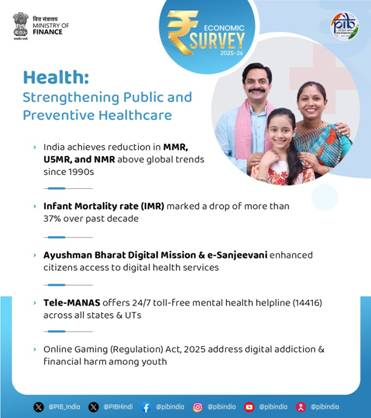
Increasing public health spending in India has led to enhanced access and affordability of preventive and curative healthcare services, as per the Economic Survey 2025-26. The survey, presented in Parliament by Finance Minister Nirmala Sitharaman, emphasized the critical role of public health improvements in strengthening human capital and economic productivity. Notable advancements include better access to healthcare facilities, nutrition, and health insurance through increased public investment in health.
The country has witnessed a significant reduction in infant and maternal mortality rates, along with an expansion in immunization coverage and primary healthcare services. Key initiatives like the National Health Mission, Ayushman Bharat, and disease control programs have played pivotal roles in driving these positive changes. Since 1990, India has achieved an 86% decrease in maternal mortality rate (MMR), surpassing the global average of 48%.
Moreover, there has been a remarkable 78% decline in the under-five mortality rate (U5MR) and a 70% drop in the neonatal mortality rate (NMR) in India, outperforming global reductions during the period of 1990-2023. Over the past decade, the infant mortality rate (IMR) in India has decreased by more than 37%, indicating significant progress in neonatal and maternal care, as well as overall healthcare and socioeconomic conditions.
The Economic Survey also highlighted the utilization of digital technologies and ICT innovations to establish integrated healthcare and insurance systems, promoting transparency and expanding access. Initiatives such as the Hospital Management Information System, Ayushman Bharat Digital Mission (ABDM), and e-Sanjeevani have not only improved citizens’ access to digital health services but also created employment opportunities, facilitated evidence-based policymaking, and enhanced hospital management.
