


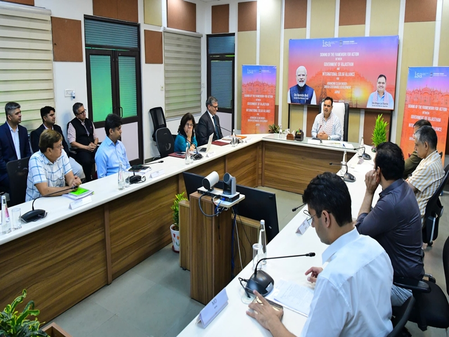
Rajasthan has made history by becoming the first state in India to ink the “Framework for Action – Advanced Clean Energy, Driven Sustainable Development” with the International Solar Alliance (ISA), a coalition of 128 nations advocating for solar power. The agreement, signed in Jaipur in the presence of Chief Minister Bhajan Lal Sharma, is aimed at expediting the state’s shift towards clean energy by focusing on solar power generation, transmission, storage, and distribution. Energy Secretary Aarti Dogra and ISA Director General Ashish Khanna formalized the framework at the Chief Minister’s residence.
Describing this collaboration as a significant achievement, Chief Minister Sharma emphasized that this partnership would reinforce Rajasthan’s standing as a leading renewable energy state in India, ensuring affordable, reliable, and high-quality electricity for its residents. He highlighted that this initiative aligns with Prime Minister Narendra Modi’s vision of propelling solar energy into a global movement through the International Solar Alliance. Rajasthan’s advantageous geographical conditions have positioned it as the largest solar energy producer in the country.
Rajasthan presently boasts an installed solar power capacity exceeding 42 GW, the highest in India, with a total clean energy capacity nearing 48 GW. The state’s ambitious target under the Rajasthan Integrated Clean Energy Policy is to achieve 125 GW of clean energy capacity in the forthcoming years. The agreement is expected to enhance the integration of renewable energy into the power grid through investments in energy storage, smart grids, digitalization, and demand-side management.
Moreover, Rajasthan is enhancing its transmission and distribution infrastructure to bolster grid stability and facilitate the extensive integration of renewable energy sources. Chief Minister Sharma underscored the advantages for the agriculture sector, noting that over 4 GW of solar capacity under the PM-KUSUM Scheme is already supplying daytime electricity to farmers across 26 districts, diminishing reliance on traditional power sources. Minister of State for Energy (Independent Charge) Hiralal Nagar highlighted that the agreement would introduce AI-based solutions to modernize electricity services, enhancing power distribution, planning, and consumer services while fortifying the state’s energy infrastructure.
The framework will steer Rajasthan’s energy transition plan for the 2030-35 period, focusing on renewable energy expansion, grid modernization, transmission upgrades, energy storage, energy efficiency, demand management, institutional capacity building, and policy reforms. A key initiative under this partnership will be an AI-enabled digital twin pilot project at Ajmer Vidyut Vitran Nigam, enabling precise electricity demand forecasting, improved network planning, efficient renewable energy integration, and enhanced power supply reliability. This collaboration will also provide engineers and government officials access to international training, technical expertise, and knowledge-sharing programs through the ISA.
ISA Director General Ashish Khanna hailed Rajasthan as the first Indian state to formalize such a framework with the alliance, presenting it as a blueprint for other states pursuing clean energy transitions. During an Energy Department review meeting, Chief Minister Sharma urged officials to expedite the implementation of the PM Surya Ghar-Muft Bijli Yojana and directed the Chief Secretary to oversee the scheme regularly to ensure timely goal achievement and rapid adoption of rooftop solar systems statewide.
