


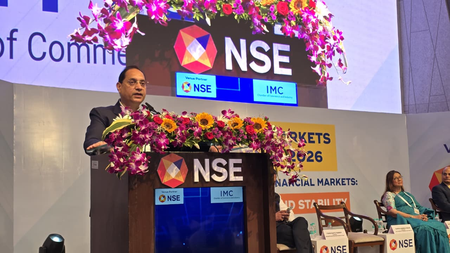
The Reserve Bank of India (RBI) and the Insurance Regulatory and Development Authority of India (IRDAI) are against banks and insurance companies participating in the commodity derivatives market, according to Securities and Exchange Board of India (SEBI) Chairman Tuhin Kanta Pandey. Pandey mentioned that both regulators have valid reasons for their position and are currently not supportive of this sector. He highlighted concerns regarding how commodity derivatives would fit with the long-term nature of the insurance business.
Algorithms potentially moving faster than human controls and digital platforms serving as avenues for fraud are among the worries expressed by Pandey. While acknowledging the benefits of next-generation AI tools in identifying weaknesses, he cautioned about their ability to exploit vulnerabilities rapidly and on a large scale.
Regarding the progress of CKYC 2.0, an initiative aimed at establishing a unified KYC system across the financial sector, Pandey informed that it is currently in the development phase. The Central Registry of Securitisation Asset Reconstruction and Security Interest (CERSAI) is spearheading this effort, collaborating with various regulators. SEBI has engaged in discussions with CERSAI to pinpoint critical issues that require attention and anticipates having a framework for CKYC 2.0 ready by the end of July.
At a recent interaction organized by the Confederation of Indian Industry (CII) and the US-India Business Council during the IMF-World Bank Spring Meetings, Pandey emphasized that India’s capital markets are gaining recognition as a stable, resilient, and globally competitive investment destination. He highlighted the evolution of Indian markets into a fundamental component of the financial system, supported by robust macroeconomic fundamentals and a steadily growing investor base.
