


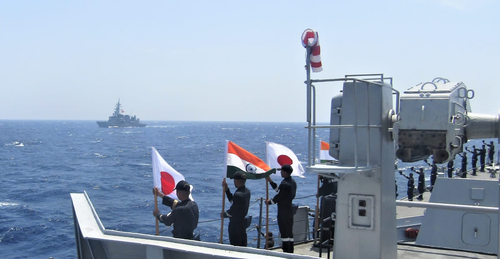
A report suggests that if the US is less willing to address China’s influence in the Indo-Pacific under Donald Trump, regional democracies should take on more security responsibilities. The India-Australia-Japan (IAJ) trilateral is proposed to be revitalized as an independent mechanism to enhance deterrence in the Indo-Pacific due to perceived diminishing US reliability. The article highlights the IAJ trilateral as a practical response to the US potentially reducing its security role in the region in the face of Chinese coercion.
The piece emphasizes that during the Cold War, the US played a major security role globally, unlike the current scenario where it seems to be stepping back from confronting Chinese coercion in the Indo-Pacific. The ‘Quad’ comprising the US, India, Australia, and Japan was set to hold a summit in 2025, but it was postponed due to trade tensions between India and the US. Uncertainty looms over the US President’s participation in the Quad, with the recently appointed US Ambassador to New Delhi suggesting it might occur in the coming years.
The report notes a slowdown in US cooperation in regional minilaterals aimed at countering China in the Indo-Pacific. This shift in US strategy opens up an opportunity for the IAJ trilateral, excluding the US, to play a more significant role in coordinating responses to Chinese maritime coercion and other pressures in the region. Despite potential limitations in countering China’s military capabilities without the US, the revitalized IAJ trilateral is seen as a crucial tool in deterring Chinese maritime coercion in the Indo-Pacific, considering perceptual factors in deterrence.
The importance of maritime security is underscored in light of China’s expanding maritime presence in the Indo-Pacific, affecting India, Australia, and Japan in different strategic areas. India faces Chinese presence in the Indian Ocean Region, Australia in the Western Pacific, and Japan in the East China Sea and the South China Sea. The report suggests that these three countries can collaborate to counter China’s influence in their respective strategic zones in the Indo-Pacific.
