


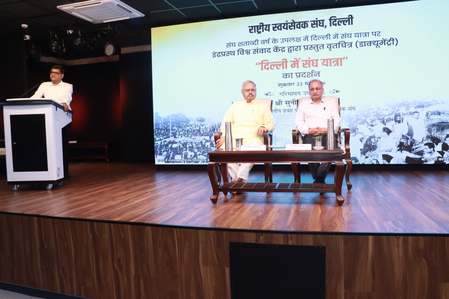
Sunil Ambekar, the Akhil Bharatiya Prachar Pramukh of the Rashtriya Swayamsevak Sangh (RSS), highlighted the rapid expansion of the Sangh between 1942 and 1947 across Delhi and Punjab. He mentioned that despite significant membership, the Sangh lacked strength during the partition, which he believed could have been prevented. Ambekar spoke at an event in Delhi where a documentary on the Sangh’s journey was screened.
The documentary showcased ‘Guruji’s’ directive to protect Hindus in Pakistan post-partition. Ambekar emphasized the sacrifices made by countless volunteers and the establishment of camps for displaced persons. He also mentioned the RSS’s non-political objective of societal service and cultural upliftment, rather than political engagement.
Ambekar discussed the early initiation of RSS activities in Delhi during Dr. Hedgewar’s tenure. He noted the organization’s deep-rooted connection to Delhi’s history and its pivotal role in national events. The Sangh’s mission in Delhi aimed at mobilizing society through its network of “shakhas” and has continued uninterrupted over the years.
Anil Agarwal, the Delhi Prant Sanghchalak of the RSS, emphasized the Sangh’s adaptability and continuity. Ritesh Agarwal, the Delhi Prant Prachar Pramukh of the RSS, highlighted the documentary’s portrayal of the Sangh’s evolution in Delhi amid the Partition era’s challenges. The film traced the organization’s growth from its inception to its current extensive presence in Delhi.
