


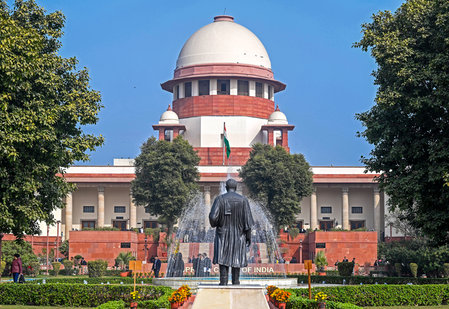
New Delhi, Aug 11 (IANS) The Supreme Court on Tuesday disposed of a public interest litigation (PIL) seeking creation of a time-bound, URL-specific and legally or judicially supervised mechanism to deal with grave forms of online harm, including rape and death threats, doxxing, exposure of children’s private details and non-consensual intimate or deepfake content.
A Bench of Chief Justice of India (CJI) Surya Kant and Justices Joymalya Bagchi and V. Mohana directed the Union government to consider the issues raised by the petitioner in his representation and take such remedial measures as may be required.
During the hearing, advocate Narendra Kumar Goswami highlighted the urgency of dealing with online threats and asked: “Suppose a woman’s home address is posted with a rape threat tonight, at 9 p.m. Will it be allowed to remain online at this stage?”
The CJI Kant-led Bench observed that the petitioner had “highlighted very well” the various modes, kinds and facets of cybercrime, but said that issues concerning their detection and preventive measures were matters for domain experts.
The petitioner then submitted that he had already raised the issue through a representation. When the apex court asked whom the representation had been addressed to, Goswami replied that it was sent to the Union Ministries of Electronics and Information Technology, Home Affairs, and Law and Justice.
In its order, the CJI Kant-led Bench noted that the petition sought directions for creation of an effective supervisory mechanism to address grave unlawful digital harms, including acts or threats of physical violence, disclosure of private particulars such as children’s school locations, non-consensual intimate content and harmful digital impersonation.
The Supreme Court recorded that the petitioner had already raised these issues through a representation dated June 22, 2026, addressed to the concerned Ministries of the Union government. “At this stage, we direct respondent authorities, along with all other stakeholders, to look into the issues raised in the petitioner’s representation and take such remedial measures as may be required,” the CJI Kant-led Bench said, disposing of the petition.
The PIL contended that digital harms can spread within minutes, while conventional legal remedies may take considerably longer, creating a gap between the speed of online harm and the speed of legal response.
The petitioner had specifically sought an emergency mechanism for cases involving specific threats of physical violence, sexual violence or death; doxxing and unauthorised disclosure of residential, contact or location details; disclosure of private details or identity markers of minor children; non-consensual intimate, morphed, synthetic or AI-generated content; and harmful deepfake or digitally manipulated impersonation.
The petition also stated that the proposed mechanism was not intended to introduce censorship or blanket takedowns, but to ensure that grave unlawful content could be addressed through URL-specific, content-specific, reasoned and time-bound action subject to legal or judicial supervision and review.
–IANS
pds/uk
