
Close Menu
  • Indian Festivals 2026
  • Movie & OTT Releases This Week
  • News
  • Entertainment
  • NRI Life
  • Research
  • Advertise with us
Facebook X (Twitter) Instagram YouTube
  • Download Indian Community App
  • Advertise Here
Facebook X (Twitter) Instagram
Indian CommunityIndian Community
Trending
  • Narasimha Jayanti Prayers: Mahamantra, Katha & Aarti
  • Vada Pappu for Narasimha Jayanti – The Sacred No-Cook Moong Dal Prasadam That Asks Almost Nothing of You
  • Neer Mor Recipe — The Chilled Spiced Buttermilk That Completes the Narasimha Jayanti Thali
  • Phula (2026) Movie Review: A Soulful Tale of Resilience and Folk Art
  • Therachaapa Movie Review: A Rooted Rustic Drama Packed With Emotion and Grit
  • Salbardi (2026) Review: A Gripping Tale of Mystery and Justice From the Heartland
  • Bad Boy Karthik Review (2026): A Brother’s Fight That Packs Enough Heart to Win You Over
  • Matka King Review: Vijay Varma’s Finest Hour in a Gripping Bombay Crime Drama
  • Indian Festivals 2026
  • News
    • National
    • International
    • Entertainment
    • Achievements
    • Scam Alerts
    • Business
    • Health & Medicine
    • Science & Technology
    • Sports
  • Entertainment
  • Latest Movie Releases
    • Latest OTT Releases
  • NRI Life
  • India & Culture
  • Health & Wellness
  • Research
Indian CommunityIndian Community
Home » News » Science/Tech
Science/Tech

Scientists Discover Semiconductor Property in Bacterial Shell Protein for Eco-Friendly Electronics

Indian Community Editorial TeamBy Indian Community Editorial TeamJanuary 10, 20262 Mins ReadNo Comments Add us to Google Preferred Sources
Scientists Discover Semiconductor Property in Bacterial Shell Protein for Eco-Friendly Electronics
Share
Facebook Twitter LinkedIn Pinterest Email

A team of scientists from the Institute of Nano Science and Technology (INST) in Mohali, under the Department of Science and Technology (DST), has found that a bacterial shell protein can act as a semiconductor. This discovery could lead to the development of environmentally friendly electronics, including devices like mobile phones, smartwatches, medical instruments, and sensors.

Traditional semiconductor materials like silicon have limitations such as rigidity, high-energy processing requirements, and contributing to electronic waste. The demand for sustainable, soft, and biocompatible electronics is increasing, especially for wearables, implantable devices, and green sensors.

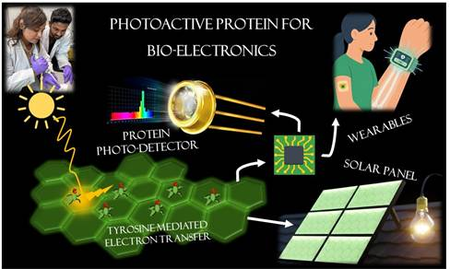
The scientists at INST conducted experiments using self-assembling bacterial shell proteins to investigate their semiconductor properties. These proteins naturally form stable, large flat 2D sheets with electron density patterns and aromatic residues, making them potentially photoactive.

When these proteins assemble into flat, sheet-like structures, they can absorb UV light and produce an electrical current without the need for additional dyes, metals, or external power sources. This behavior makes them function as light-driven semiconductors, similar to materials used in electronic circuits and sensors.

The team observed that the proteins arrange themselves into thin, sheet-like structures, and when exposed to UV light, they exhibit movement of tiny electrical charges across the protein surface. This movement is facilitated by the presence of tyrosine, a natural amino acid in the proteins that releases electrons when stimulated by light.

The discovery has significant implications for practical applications. The flexible and biocompatible nature of the material opens up possibilities for creating wearable health monitors, UV-detection patches safe for the skin, and implantable medical sensors suitable for use inside the human body. Additionally, the proteins could be utilized in temporary environmental sensors like pollution detectors or sunlight trackers that naturally degrade after use, posing no harm to the environment.

Families, patients, and consumers may soon benefit from the development of soft, comfortable, and environmentally friendly devices that seamlessly integrate into everyday life.

Bacterial Shell Protein Department of Science and Technology Electronics Environmental Sensors Institute of Nano Science and Technology Royal Society of Chemistry Semiconductor sensors Wearables
Add us to Google Preferred Sources
Indian Community Editorial Team

The Indian Community Editorial Team curates, verifies, and publishes stories that matter to Indians worldwide. From culture and community to business and innovation, our mission is to spotlight voices, ideas, and events that bring our global community closer together. Have news or a story to share? Submit it to us at [email protected].

Add A Comment

Former Manchester United Defender Alex Telles Scores Late Winner for Botafogo in Copa do Brasil

April 22, 2026

West Indies Championship Match Abandoned Due to Unsafe Pitch Conditions

April 22, 2026

Anupam Kher Shares Spiritual Encounter with Swami Avdheshanand Giri on Flight

April 22, 2026

Mammootty and Suresh Gopi Express Grief Over Thrissur Explosion Tragedy

April 22, 2026
  • Facebook
  • Twitter
  • Pinterest
  • Instagram
About Us
  • About Us
  • Contact Us
  • Terms of Service
Corporate
  • Download Indian Community App
  • Advertise Here
Facebook X (Twitter) Instagram
  • About Us
  • Contact Us
  • Terms of Service
© 2026 Designed by CreativeMerchants.

Type above and press Enter to search. Press Esc to cancel.