


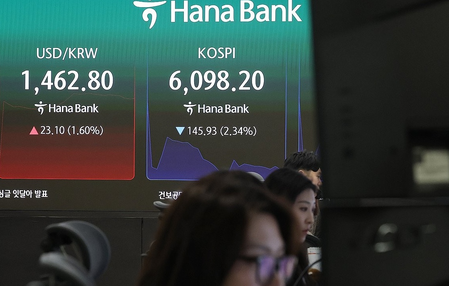
South Korean stocks experienced a significant drop of almost 5% late Tuesday morning due to escalating worries about potential economic repercussions from the ongoing conflict in the Middle East. The Korea Exchange (KRX), the main bourse operator in South Korea, implemented a sell-side circuit breaker to temporarily halt trading following a sharp decline triggered by concerns over U.S. airstrikes on Iran. The KOSPI 200 Futures index trading was paused for five minutes at 12:05 p.m., as reported by KRX.
The index saw a decline of 47.75 points, equivalent to 5.09%, reaching 890.05 at that time, marking the first sell-side circuit breaker since January 6. A sell-side circuit breaker is activated when the KOSPI 200 Futures index drops by 5% or more for at least one minute. The benchmark Korea Composite Stock Price Index (KOSPI) opened 1.26% lower and fell by 246.98 points, or 3.96%, to 5,997.15 by 11:20 a.m. in the first trading session post the U.S.-led attacks on Iran, according to Yonhap news agency.
The South Korean financial market remained closed on Monday in observance of the March 1 Independence Movement Day holiday. In the U.S., stock markets closed with mixed results as investors processed the U.S. air strikes on Iran, with the Dow Jones Industrial Average dropping by 0.15% and the Nasdaq Composite gaining 0.36%. Notably, major shares in Seoul led the decline, with Samsung Electronics witnessing a 5.2% decrease and SK hynix, its chipmaking rival, plummeting by 5.66%.
Samsung Biologics, a prominent pharmaceutical company, experienced a 3.77% loss, while Korean Air, the flag air carrier, saw a significant 8.99% decline. Conversely, S-Oil, an oil refinery firm with Saudi Arabia’s Aramco as its largest shareholder, surged by 16.45%, and defense giant Hanwha Aerospace soared by 11.72%. The Korean won was trading at 1,467.3 won against the U.S. dollar by 11:20 a.m., reflecting a decrease of 27.6 won from the previous session.
