


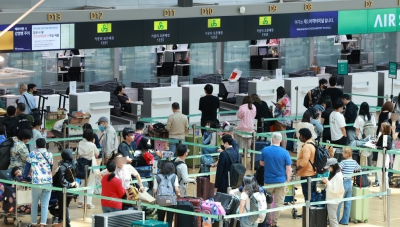
South Korea’s aviation sector witnessed a significant decline in output in April, the sharpest drop in 52 months, primarily attributed to increased fuel surcharges linked to the prolonged Middle East conflict. Data from the Ministry of Data and Statistics revealed that the production index for the aviation sector fell by 13.5% to 468.5 in April, marking the largest monthly decline since December 2021.
Passenger transport output within the aviation sector also experienced a notable decrease of 14% in April compared to the previous month, representing the most substantial on-month decline since December 2021. The decline in aviation output was largely a result of decreased airline passenger demand, influenced by the surge in fuel surcharges.
The statistics agency pointed out that Korean Air, the largest full-service carrier in South Korea, raised its international one-way fuel surcharges significantly for April, ranging from 42,000 won (US$27.86) to 303,000 won, up from 13,500 won to 99,000 won in March. This increase was in response to the Mean of Platts Singapore (MOPS) benchmark for refined petroleum products in the Asia-Pacific region, averaging $214.71 per barrel between March 16 and April 15, placing fuel surcharges for the month in the highest Level 33 bracket.
Amid escalating fuel costs and dwindling passenger demand, local low-cost carriers have taken measures such as reducing round-trip services, implementing unpaid leave, and other emergency actions. Jeju Air Co., South Korea’s largest budget airline, has slashed nearly 200 round-trip international flights, equivalent to 4% of its total operations, on various routes during May and June, including those from Incheon to Bangkok, Singapore, and Vietnamese cities like Da Nang and Phu Quoc. Additionally, the airline has suspended its Vientiane route for two months since late April.
